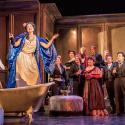
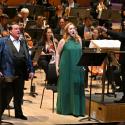
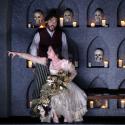
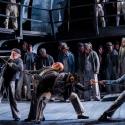
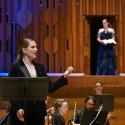
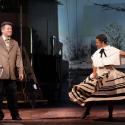
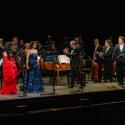
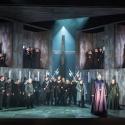
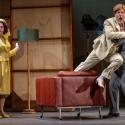
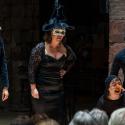
In fact Giuseppe Frigeni’s production and sets have already been seen in Bordeaux, so perhaps it’s more that the novelty by now has worn off. Either way, it’s a miserable affair, devoid of movement or dramatic tension, obscure in its characterisation and motivation, poorly lit and self-evidently costumed not just for a different cast, but for a different race of men and women.
It has some of the worst singing I’ve encountered on the professional stage for many a year; and where the singing is good, it mostly comes from the wrong kind of vocal chords. In Meistersinger the orchestra played like well-drilled angels for their music director, Lothar Koenigs; here for him they play like a pick-up band of goodish players. Even the WNO chorus is something less than wonderful, an extremely rare event.
What has gone wrong? It’s always hard to pin down the cause of these occasional disasters (and of course they happen to every company at one time or another). But this show reeks of under-preparation and lack of direction. The very first bars of the overture on the first night sounded coarse and untidy, and though matters improved, the playing remained patchy with a few highlights, notably some lovely oboe work in Act Two.
Behind the overture Frigeni offers the now inevitable dumb-show of “explanation” in which what one takes to be the main characters drift around gesturing to one another, coming and going, in an utterly babyish, unhelpful, and above all (because it’s a very undramatic overture) musically inapt fashion. A huge steel cage swivels round then settles beside an elegant rococo doorway: the production’s insignia, such as they are – the cause and the effect.
When the non-existent curtain rises, the same idiom persists. The singers circle round each other more or less irrelevantly, and much of the action proceeds as a kind of mime, since Frigeni drops most of the dialogue, and what takes place seems completely unmotivated in any real sense. The canon quartet is given no spoken context at all, and when Leonore and Marzelline join hands at the end it’s as if they were enacting some impenetrable ritual, and one half-expects a Tippett-like magus figure to appear in a white cloak.
The prisoners are let out into the yard for no known reason. In the dungeon scene, Rocco and Leonore pretend to be in danger from some cavernous menace that Frigeni forgot to design; then suddenly aren’t any more. Of personal electricity between them and Florestan there is little or none. Timing, placing, chemistry: all practically zero.
Some of the blame lies with Amélie Haas’s costumes, some with the singers themselves. Whoever originally wore Leonore’s grey suit, I’ll wager she wasn’t Lisa Milne’s shape; it’s idle to pretend such things are unimportant, because opera is after all theatre, and theatre is a visual medium. Milne is a lovely singer, but she is no Leonore, at least not yet. She lacks weight in the lower voice, while the top is that of a Susanna or a Micaëla, both parts that she has sung with success.
Dennis O’Neill, a great singer for this company in the past, should please retire with a knighthood. His Florestan is simply not viable: forced and approximate, with poor German and an appearance one can only describe as that of an ageing tenor. Unkind? Thousands of punters are paying big money to see and hear him. They deserve better.
Of the rest, Elizabeth Donovan’s Marzelline is the one bit of casting that both looks and sounds right. Her opening duet with Jaquino (Robin Tritschler) and her song are charming, though marred by the drifting and the dumbshow. Clive Bayley makes an interesting attempt to hit off Rocco’s horse-sense humanity, but spoils it by snapping at the notes. Robert Hayward’s Pizarro, a fine, villainous SS colonel, barks his part with such ferocity that the notes almost vanish. Quentin Hayes’s Don Fernando is upstaged and barely audible.
At the helm of all this, Koenigs’s role is mysterious. There is energy in his conducting, but of a brusque, unsubtle kind. Occasional beauties emerge like memories of something lost. But as a whole Beethoven’s great score is wretchedly served, and his drama – naïve, improbable, intractable but when done right overwhelming – goes rapidly down the cistern.
- Fidelio at the Wales Millennium Centre on 25 Sep and 1 and 8 Oct, then touring