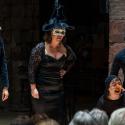
We love Gareth Malone, don’t we? We are big fans of the Pied Piper of primetime. And so we should be. The youth of today seem impressively eager to down tools, put away childish things like knives and drugs and safe-cracking equipment, and follow this slightly weedy and totally uncool choirmaster out onto the concert platform. Our glorious new coalition should be using him to tackle crime. No sooner does he move into a tough working-class ‘hood wielding nothing more than a Michael Jackson songbook than the figures for shootings, muggings and moochings about on street corners drop through the floor. He’s got a bit of a steep ascent with his new task, mind.
Opera? It’s one thing encouraging tuneless urchins to attempt something catchy from the Motown back catalogue. But there is tunelessness and there is tunelessness. Gareth would like to teach the world to sing in perfect harmony, but what if there aren't any harmonies or hooks or indeed any kind of musical handrail? Well, the bar goes a little bit higher. No wonder Gareth kept telling us how terrified he was in the first episode of Gareth Goes to Glyndebourne.
If you've seen The Choir, the mise en scène is superficially a case of as you were. Gareth goes scouting for talent in the sink estates, and deploys his unthreatening brand of charisma and empathy to coax them towards self-belief, with possibly a spot of civility thrown in. As ever Gareth does his completely engaging thing: part speccy teen, part tweeded young fogey, he is disarmingly enthusiastic, ever trusting and never confrontational. You can set your watch by the moment you have to switch on the windscreen wipers.
But the difference is that this time the kids have got to be more than all right. They’ve actually got to be able to sing. And act. And move in complex choreographic shapes for the entire length of an operatic performance of a work not notably burdened with what any of them would have recognised as music. Plus it’s all happening at Glyndebourne, the very innermost sanctum of the citadel of privilege, elitism, poshness, cummerbunds, tiaras, Aston Martins - you name it, they've got all the symbols of the old order mustering on a few square yards of nail-clippered picnicking lawns. On a sunny evening, Gareth donned his dicky bow and squired his lovely wife there, just to give us all a whiff of the world of hyper-wealth his new ensemble would be infiltrating.
 You can see what’s in it for Glyndebourne. They get three hours of prime rebranding on national television. But what’s in it for the choral recruits is the real story. The opera is Knight Crew, based on the novelist Nicky Singer's inner-city update of the Arthurian legend. Gareth’s job was to find and train a 50-strong chorus. Last night was largely about schlepping around schools and scary youth clubs, looking for volunteers.
A lot of it looked like genuinely thankless work. In one club a gang of ne’er-do-wells ornamentally blanketed in tats and piercings, hair hardened into aggressive attitudes, all pretty much turned their back on Gareth when he asked if they liked singing. Even the TV camera held no interest for them. One charming young gentleman refused to audition with a Jacko song on the grounds of what he gets up to (more correctly got up to; even more correctly, didn’t actually get up to, according to the Californian courts) with children.
In due course Gareth managed to lure hundreds to a series of workshops, whittling them down slowly from 200 to 100, who all had to sing the first line of “Over the Rainbow” to a judging panel. The words movingly attested to the wishful nature of the project. You can object to the familiar trickery, the strict adherence to grammatical tramlines. You can tire of television’s ceaseless desire to codify class distinctions. You can object, if that way inclined, to the music by Julian Philips. But Gareth Goes to Glyndebourne feels like a charming experiment in cultural engineering. Opera gets a leg-up. So do some less lucky children in Sussex. And we all get to enjoy a warm glow that feels only minimally like the product of manipulation.
- Watch Gareth Goes to Glyndebourne on BBC iPlayer
- Knight Crew opera website
- Find Knight Crew by Nicky Singer on Amazon
Watch a performance from The Choir