God-sent sea monsters and divinely ordained human sacrifices don’t wash well with opera updated. The favoured contemporary take on the post-Trojan War myth of Mozart’s Idomeneo, which may even have originated in the last Covent Garden production 25 years ago by a fitfully brilliant Johannes Schaaf, has been to put a populace at risk from natural disaster and pestilence. Clearly the programme was expecting something of the sort, with its images of Hurricane Katrina. But no, for director Martin Kušej, the only monster is the state.
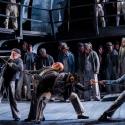
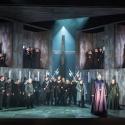
Chuck out a cosmic dimension in favour of power struggles, though, and they’d better not be petty or ludicrous, as they are in this case with posturing blokes in black suits and reflector specs, a hardly threatening bunch of Goth-priests – all the Goths I’ve met have been such nice people underneath – and weedy red-wrapped revolutionaries. There’s not a moment of human truth in this production, which makes it very hard on the singers.
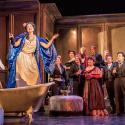
 Take the central relationship. To appease Neptune, a king must sacrifice the first human being he sees on landing in Crete, which happens to be his own son. But Kušej’s Idomeneo is not the one of Mozart’s old libretto, torn between love and compulsion. He wants libertarian Idamante dead: obstacle number one to the music’s polarities of severity and tenderness. Obstacle number two: no-one really loves anyone else, but everyone seems keen to get off with each other. Tacky, especially when Idamante succumbs to the clichéd straddling-to-hysterical-vocals of wild Elettra. And come the monster-attack, the chorus is singing about running and hiding from the Great Terror when they’re rooted to the spot by the daft johnnies with guns – one of three weak curtains (the first involves a giant rubber shark, just about the only representative of the all-important sea, pictured above). Annette Murschetz’s revolving black and white cubes and walls, a marine-free zone, say nothing to me about the nature of the drama.
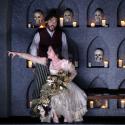
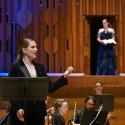
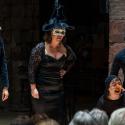
It’s difficult to believe in Mozart's first through-composed masterpiece, its generosity, rifts and dazzling woodwind elaboration, when the motivation is so uncertain. Glorious Sophie Bevan starts out on top form, clear of Italian diction and expression as captive Trojan princess Ilia, but as her morals start to slide – prospective dad-in-law tries it on, she seems to like it but isn’t sure and nor are we – so does interest in her character, at least until the great Act Three Quartet, which she crowns superbly. Malin Byström’s Elettra is vocally less well-defined, but she’s there for the thrilling, if ultimately wearing, upper range – and she looks stylish in black and white, if going nowhere with it.
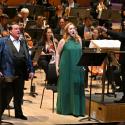
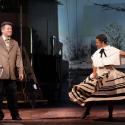
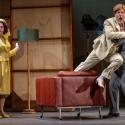
 Strong tenor Matthew Polenzani’s Idomeneo (pictured left with Bevan's Ilia) not only sings the coloratura-free, tame version of his centrepiece aria "Fuor del mar" but has the conviction in his voice sapped by the physical uncertainty with which Kušej saddles him: like everyone else, he just paces the stage ineffectively. A second tenor, Stanislas de Barbeyrac, is asked to bring eccentricity – bust accordion, eye patch, woolly hat, why? – to dull counsellor Arbace. He sings his heart out for the aria that begins Act Two, but it’s still Mozart’s most perfunctory number. Argentinian counter-tenor Franco Fagioli is no actor, and who wants to hear an Idamante who bottles up top rather than opening out, as every mezzo I’ve heard in the role has managed to do, and with more masculine welly, too? Bring on Alice Coote, Christine Rice, Sarah Connolly; don’t foist a Mozart counter-tenor on us again, please.
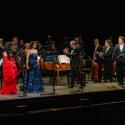
Chorus and orchestra are vivid, but hampered at times – the players by the mannerisms of Marc Minkowski, who of all authenticists manages to over-romanticise Mozart, however authoritatively, and abetted by clunky continuo playing; the singers by Kušej trusting them so little that he sticks at the front of the stage an expensive group of 27 actors to do what the chorus could surely achieve with good direction. You expect the action men to leap into action for the ballet at the end of the opera, often cut; here we get part of it, but to a revolve of miserable, oppressed children – the ones in white who puzzled us during Elettra's first aria – and adults turned to stone by the ongoing cycle of tyranny: a suitably frigid conclusion to a dud staging of zero human interest. Don't get me wrong: good Regietheater, like Schaaf's Idomeneo here back in 1989, can challenge and inspire, but this is the sort of thing that gives the genre a bad name.