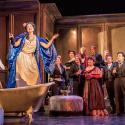
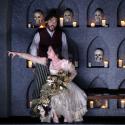
And so the Academy of Ancient Music’s triptych of Monteverdi operas at the Barbican comes to an end, three years after it began with Orfeo. If 2014’s Poppea was the cycle’s sexually-charged climax, then this Ulisse is the dark, contemplative coda – a sobering moment of morality after the victorious excesses of opera’s most venal couple.
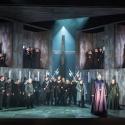
Il ritorno d’Ulisse is always a harder sell than Poppea. Virtue, chastity and constancy don’t make for quite such an obvious drama, and the opera’s structural oddities – a complicatedly large cast, an awkward final act – make it tricky to pull off. Benedict Andrews’s 2011 production for ENO, however, was a miracle of psychological horror, a memory still hot behind the eyes.
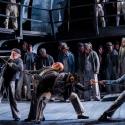
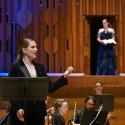
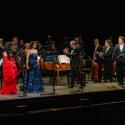
 Without the Young Vic’s technical toolbox to play with, directors Alexander Oliver and Timothy Nelson opted for a clear and unfussy staging, making the most of the Barbican Hall’s wide sightlines, balconies and aisles by bringing the action out into the audience. Monteverdi fills the gaps where sex and murders fit elsewhere with dramatic visual effects – Minerva’s flying chariot, Neptune turning the sailors to stone. Ingenious lighting solutions supplemented any lack of spectacle, focusing us more closely on the inner dramas of these minutely drawn characters.
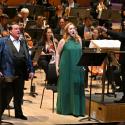
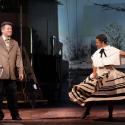
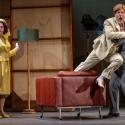
Ian Bostridge’s Ulisse (Bostridge, above right) may not quite be Homer’s wily wanderer, but there’s a rangy urgency about both his physicality and vocal delivery that brings real menace to the king-in-disguise. Deploying everything from a bladed snarl to mezza voce croon, his hero is war-broken and complicated, but redeemed in Monteverdi’s exquisite final duet – a flowering of melody after unyielding recitative. If Barbara Kozelj’s Penelope wasn’t quite his match, it was a quiet disparity. Slightly underprojected, the role seemed to sit awkwardly for her and quite a lot of silent vocal mechanics were audible. Her charged stillness, however, offered an essential centre around which the opera’s complex action swirled.
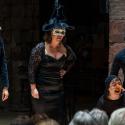
 Elizabeth Watts (pictured left) romped and cackled her way through the evening as Minerva, dispatching the Goddess’s rage-coloratura with unarguable polish. In Charmian Bedford’s Giunone she had some serious rivalry, though; Bedford’s late-entry cameo commanded and demanded attention, all gloss and athleticism. Elsewhere there was an unusually touching Eumete from Christopher Gillett as well as some predictably beautiful singing from Andrew Tortise as Ulisse’s son Telemaco. Sophie Junker was a delicate Melanto, paired with a slightly stiff Gwilyn Bowen as Eurimaco, and Lukas Jakobski delighted in a thunderous Neptune, reeling it back later as lover Antinoo.
Directing from the harpsichord, Richard Egarr kept the pace measured but always energised, encouraging a wonderfully free-form reading of the score (such as it is), which always placed expressive impact and emotional authenticity over absolute fidelity.
Monteverdi’s late-in-life opera is a psychological study in grief, love and survival. It has its quirks, but the music alone is so flexible, so contemporary as to give hope that it may yet see a busier life in the opera house. Till then, however, semi-stagings like this one are a very satisfying substitute – an appropriate homage both to Monteverdi himself and also to critic and writer Andrew Porter, to whose memory this performance was dedicated.