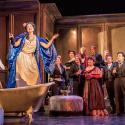
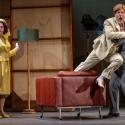
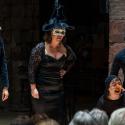
It's amazing how long it takes to realise that we're in the 1970s in Michael Grandage's new Glyndebourne production of Le nozze di Figaro. The mansion house suggests that we're in the 18th century. The light and latticework says we're in Mozart's original Seville. The poor villagers that scurry about during the overture preparing the stage for visitors could be from pretty much anywhere Mediterranean and from any century. It's only when the Count rolls up in a 70s sports car, wearing a concorde collar and flares, that it really dawns on us that we are in the decade of free love.
Traditionalists might gulp at all this. They will wonder how class conflict will survive. Can the Count's aristocratic privilege - his feudal right to bed his servant Susanna, his waiving of which is crucial to the plot - make sense in a 20th century context? In a way, of course, it can't. Yet the fact that the detail doesn't completely jar is fascinating. It reminds us that social liberation hadn't completed its course during this decade. The head of a house did still have a right to his staff in the 1970s, an unofficial one that was administered with a nudge and a wink rather than a command.
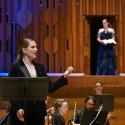
There was real sophistication to Ticciati's interpretation
The rest of the dysfunctional relationships thrive in a Seventies context. This was the decade that virtually invented the unhappy suburban marriage. And here we have the archetypal comfy middle aged couple, the Count and Countess, on a recuperative holiday break, engaging in the sexual shenanigans that the philosophy of their age encouraged but finding no liberation in any of it, dissatisfied with their lives, on the verge of divorce.
The only aspect of Mozart's opera that is lost is the class-driven edge to the relationship between the Count and Figaro. Detached from its context, this battle of wits becomes a private squabble rather than a symbol of a wider social conflict. But the problem here lay as much in Vito Priante's under characterised Figaro as in Grandage's overall concept. What Priante lost in character, however, he gained in vocal control. Audun Iverson's Count had the opposite problem. Here, the characterisation was vivid and the vocal line vague.
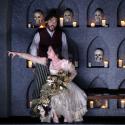
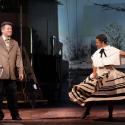
The girls were much better at marrying vocal control with stage presence. Lydia Teuscher's Susanna was fantastically alert, her voice full of a flickering energy. Isabel Leonard's Cherubino was spry, jerky, flirtatious and seductive - everything you'd want from a Cherubino (pictured below with Teuscher). Ann Murray's Marcellina was brilliantly shrill, Sarah Shafer's Barbarina pretty. Though the absence of a sotto voce denied Sally Matthews' Countess the potency that the character should have, her subtlety on stage, the way she captured the feeling of being adrift in this semi-liberated new world, was captivating.
 With any update to the 1970s, there is always the opportunity - and temptation - to milk the sitcoms that, inevitably, these 18th and 19th century opera buffa resemble. Grandage's refused to over-emphasise this, though it was impossible to avoid the echoes, especially in Alan Oke's perfectly pitched Don Basilio. Rejecting comic hyperbole meant that Grandage could focus on realism and truth, though it also meant that certain farcical elements fell a little flat. Had he dropped the high-mindedness for a moment and chiselled the Act Two bedroom farce according to the cruder rules of TV comedy the climax would have made more impact.
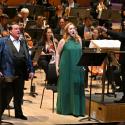
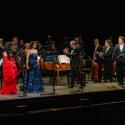
Luckily we had Robin Ticciati in the pit, who, though he proceeded at a moderate paced, kept a thread going through the bedroom and garden scenes when the energy on stage began to flag. There was real sophistication to Ticciati's interpretation. Using every textural possibility that the Orchestra of the Age of Enlightenment afforded him, he revelled in the musical detail, emphasising psychological nerviness by bringing out chromatic instabilities.
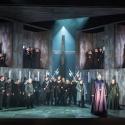
Grandage's desire for naturalism, however, was great boon for the eyes. Opera productions set in the 1970s tend to provoke designers into providing clown costumes and whacky wallpaper in the name of irony. Not here. Christopher Oram's designs were sober, elegant and ravishing. The Moorish tiling and fan-backed chairs weren't there to make any sort of statement (except possibly to say "buy me"). They were there to facilitate the reality that the characters found themselves in. But not making a statement on stage is the biggest statement you could make. Modest, modish, the set became one of the evening's chief attractions.