I’m all in favour of the EIF taking artistic risks, and of them bringing a high-prestige international production to Edinburgh. This Marriage of Figaro from Berlin’s Komische Oper is both of those things, because it is the first production by Kirill Serebrennikov – the high profile Russian director, placed under house arrest by the Putin regime, now based in Berlin – to be seen in the UK.
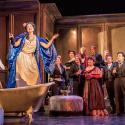
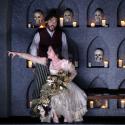
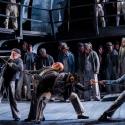
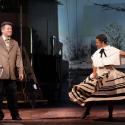
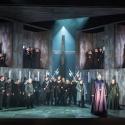
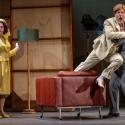
But the EIF agreed to host it before its Berlin premiere, and while they must have had their suspicions about how “radical” it was, I doubt they were prepared for just what a mess it turned out to be. For one thing, it didn’t fit the stage of the Edinburgh Festival Theatre. Serebrennikov divides the stage horizontally in an upstairs/downstairs model, but I heard lots of people in the theatre’s upper circle complaining that they couldn’t adequately see what was going on in the downstairs section. Maybe they were the lucky ones, because I could see it all and thought much of it was an unholy mess.  The stage’s division puts the Count’s home on the upper part with the servants’ grimy quarters beneath. The Almavivas’ house is full of expensive-looking contemporary art and in fact, by the time of Act 3, it isn’t clear whether it’s their home or in fact a gallery, as guest are shown around the exhibitions at the end of Act 3 during what should be the fandango. It’s a neat idea, if hardly an original one, to contrast the venal aristos with their put-upon servants; but Serebrennikov clearly doesn’t know what he’s trying to do with it. Is he trying to say the rich are nasty exploiters? If so, get to the back of the queue, Kirill: directors have been saying that for decades, especially at this house.
He clutters the stage with non-singing characters who, ironically, make a terrible racket with their actions. Cherubino becomes a mute character who can only communicate through Cherubina, a mezzo-soprano in love with him who translates his sign language for the other characters. Her presence does away with any need for Barbarina, incidentally. Furthermore, the music is cut up and spliced so that arias appear in places other than where Mozart intended them. Worse, the introduction to the "Dissonance" String Quartet appears in Act 4 and, most egregiously, Act 3 begins with the farewell trio from Così fan tutte.  It's entertaining at times, not least when you’re trying to guess what’s coming next, but the big unanswered question about the whole production is: why? I didn’t notice a single revelation from any of Serebrennikov’s directorial decisions, and some of the musical cut-and-paste must surely have been designed primarily to provoke rather than to enlighten. Most damagingly, all of this put a layer of distancing between the music and the audiences. Of all operas, this should be the one that should speak most directly to our human foibles and to our capacity for love and forgiveness, but this is fatally weakened when you’re busy wondering why a mass stabbing has just taken place in the art gallery, or whether the whole thing is taking place in the Count’s imagination.
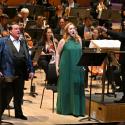
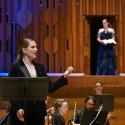
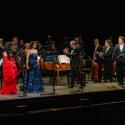
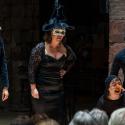
There were musical consolations, with some really strong singing in the cast I saw, particularly from the ladies. Verity Wingate’s Countess (pictured below) was rich, creamy and luxurious, while Penny Sofroniadou’s Susanna was agile and bright. Karolina Gumos was young for a Marcellina, and invested a whole new energy into the character’s music, while Patirica Nolz did all she could with Cherubina. Hubert Zapiór gave a sexy virility to the Count’s music, while Peter Kellner’s Figaro was mischievous and vigorous. The Komische Oper orchestra sounded fantastic under conductor James Gaffigan, who kept everything moving with terrific zing, though how he was persuaded to go along with the textual jigsawing is a mystery to me.  None of this, however, made up for a theatrical experience that felt like cocking a snook at the audience in a way that Serebrennikov doubtless thought would be provocative but which ended up being just plain tedious. During Act 3 of the performance I saw, one audience member had clearly had enough and yelled out “Boo! Outrageous!” At least he cared. By that point I think I’m not sure I did any more.