Frederick Delius composed an opera called A Village Romeo and Juliet; Donizetti composed a sort of village Tristan and Isolde, but called it L’elisir d’amore – The Love Potion. The hero, Nemorino, inspired by the Tristan tale, buys an elixir off a passing quack, in the hope it will make the beautiful, capricious Adina fall for him.
But, arguably like Wagner’s, the potion is fake (red wine, in this case, probably throat lotion in Wagner’s), and Nemorino gets his girl because he unknowingly inherits a fortune, the village girls fawn over him, and Adina becomes jealous.
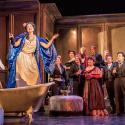
How much of this agreeable nonsense in an 18th-century Basque village makes sense transplanted, in Max Hoehn’s Longborough production, to some semi-modern English village probably at the far end of Metroland, complete with defibrillator, red phone booth, bobby and postman, and builders in hard hats and dayglo jackets, is an open question. Metro-man may be gullible, but would hardly queue to pay for a palpably phoney cure-all medicine.
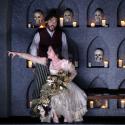
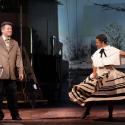
But once one has got over the mild shock of Nemorino as the village postman (also in hi-viz), the necessary suspension of disbelief quickly sets in, and the Postman-Pat charm and clutter of Jemima Robinson’s set design evolves into a never-never land of pantomimic frolic, not always perhaps in the best taste, and occasionally irritating in detail. Why, for instance, does Belcore, a stuck-up, lady-killing regimental sergeant in the original, come on here as a crashed airman, a change that creates problems later on and apparently necessitates the omission of his platoon of soldiers? And why is Nemorino, on a Royal Mail salary, so broke that he has to join Belcore’s air force to get the money to buy the elixir? It’s true he doesn’t seem to deliver many letters… (Pictured below: Thando Mjandana as Nemorino and Emyr Wyn Jones as Dulcamara)  With the music though – some of Donizetti’s most enchanting – there are no such incongruities, and the cast is generally strong. Jennifer Witton is a sparklingly agile Adina, athletic of voice, and she moves well enough on stage. She offers fine variation of vocal colour and a vivid stage presence. Her final duet with Emyr Wyn Jones’s quack Dulcamara is a high spot of the evening, including a spectacular two-octave descent that I can’t find in the score – so what’s new? Wyn Jones is a no less incisive Dulcamara, a brilliantly articulate patterer, and with suitably dark colourings for this fraudulent, mountebank medicine man.
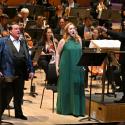
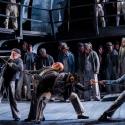
I also like very much the Nemorino of Thando Mjandana, from South Africa, a more muscular tenor than often in this role, but perfectly capable of tender shades in “Una furtiva lagrima”, and a clever actor between the forlorn and the cocky that alternate in this interesting character, so vaguely defined socially by Donizetti and perhaps a little too precisely defined by this production.  Arthur Bruce’s Belcore (pictured above with Witton) is less wholly convincing, and scarcely helped by being in a sense demilitarised. But the lead village girl, Giannetta, is neatly played and immaculately sung by Haegee Lee as a schoolgirl on a scooter. Good at steering as well. Alice Farnham conducts a lively, stylish orchestral performance, unobtrusive in the best bel canto sense but with some lovely touches, like the high bassoon in “Una furtiva lagrima”, one of Donizetti’s best finds. She also works well with her very small chorus, staged as a set of village types, but perfectly integrated as a choir.