It’s easy enough to see the difficulty Madam Butterfly places your thinking director in. I share her pain. What the whirring brain will quickly see as a penetrating, or at least surface scratching, study of a whole repertoire of modern obsessions – cultural appropriation, colonialisation, child abuse, sexual predation – turns out to be merely Puccini’s latest bout of sublimated girl-bashing, accompanied by some of his most sadistically beautiful music.
For Lindy Hume, the director of WNO’s new production, Butterfly is no longer the fragile, accidental victim of a horrid American sailor on a one-night stand, but a damaged, calculating teenager procured for a wealthy client with the promise of escape from her ghastly, controlling family. So far, so plausible. But the attempt to see this sad little episode as a paradigm of what Hume calls real-world contemporary parallels in a dystopic near-future version of our own society (including, presumably, one that reached its dénouement in a New York court only the other day) is a great deal more problematic.
Puccini didn’t just set his story in turn-of-the-century Japan, he set his music there as well. Detail after detail in the score locates it, for better or worse, in the quasi-fictional Japan that had already been brilliantly satirised by Gilbert and Sullivan in their Mikado a couple of decades earlier. And like music, like text. Line after line describes the delicate beauty of the little house, with its sliding doors, its flowers and its enchanting view of Nagasaki harbour.
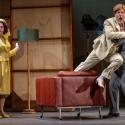
The exquisite setting is a deliberate irony, like the gardens in Mozart, sweet, managed disguise for hideous, anarchic goings-on. To replace all this, as Isabella Bywater does, with a revolving airport control tower in a big white box, and to replace the flowery dresses and fluttering fans with silly, prancing girls in fluffy tutus and family elders in suits and twin sets is to kill the irony stone dead and make nonsense of the music. Hume calls this capturing the work’s polarities: but they are the wrong polarities, ones which ridicule the authentically alien alongside Butterfly’s sincere, touching embracing of her husband’s culture, here parodied by a bank of washing machines, a kitchen bar and what we are now allowed to call a toilet, while the music pursues its own delicious, unheeding course.
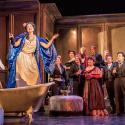
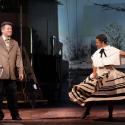
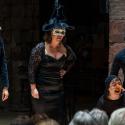
 I’m sorry to say that I found the sheer ugliness of this production a distraction from its serious elements and above all from the music, mostly well played and sung under Carlo Rizzi. Joyce El-Khoury (pictured above with Mark Stone and amenities) is a strong Cio-Cio-San, with fine, controlled tone across a big range, and a great sense of style, but she is unbecomingly dressed and visually miscast because too tall beside Peter Auty’s Pinkerton, who goes on about her small stature. Auty himself (second-cast to Leonardo Caimi, who sang the first two nights) gets Pinkerton’s coarseness of manner and appearance almost too well, sings (including his final act aria) with eloquence but occasionally rough tone, while the Sharpless, Mark Stone, seemed out of sorts at this third performance, never quite finding the lyricism that Puccini set against Pinkerton’s brashness.
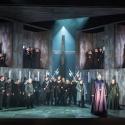
I enjoyed Keel Watson’s brief but emphatic Bonze and Tom Randle's depersonalised but expertly sung Goro more, and especially Anna Harvey’s Suzuki, a real portrait and musically incisively, if not much helped by being modernised, in the second act, into a Californian 20-something out of a TV soap. The chorus likewise survived some fairly unhelpful costuming and movement. One can lose the Japanese context if one must, but what replaces it needs to echo the refinements of the original, not kick them into oblivion.