When we first meet Sarah, the teenage heroine of Freya Waley-Cohen’s WITCH, she’s alone in her bedroom Googling “How to stop feeling shitty?”. She’s being bullied and sexualised by boys at school, but she could just as easily be asking on behalf of any one of her operatic forebears: Manon; Carmen; Armida; Alcina; Butterfly; Elvira.
This triple bill, which frames Waley-Cohen’s new work with Monteverdi and Strauss’s takes on the abandoned and betrayed Ariadne/Arianna, offers a statement about the female experience – AKA operatic variations on feeling shitty.
Too often lectures when it should live its own theatrical life
Waley-Cohen, a Royal Academy alumna, steps into new territory with this substantial new work, premiered as part of the RAM’s Bicentenary celebrations by the creative dream-team of director Polly Graham and conductor Ryan Wigglesworth.
The source-material is rich and intriguing: Rebecca Tamas’s poetry collection Witch, Waley-Cohen’s own family history with Salem witch trials, as well as the sedimented layers of female power, anger and resistance that run right through opera, from Monteverdi to today. But so much anger and emotion, so much history, doesn’t come lightly or willingly, and the result too often lectures when it should live its own theatrical life, gives us chapter and verse instead of flesh and feeling.
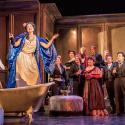
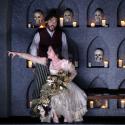
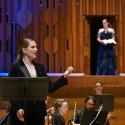
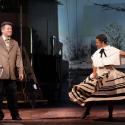
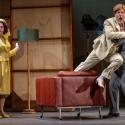
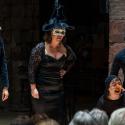
 Hurt and angry, schoolgirl Sarah (Sophie Sparrow, above) is drawn into an online coven of witches, whose Insta-friendly affirmations and incantations begin and end in cyberspace. But when her own spells take magic into the real-world, she’s drawn into a connection with Jane (Bernadette Johns, below), a 16th-century Scottish woman accused of witchcraft.
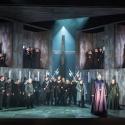
The parallel structure should amplify, but there’s just too much material and too little time for either Jane or Sarah to be much more than a vessel for the often undigested ideas of Ruth Mariner’s libretto. It’s hard not to think of James Macmillan’s The Confesssion of Isobel Gowdie, the wordless ferocity and tenderness, the layers of incantatory magic and incense-heavy chant that the composer found in the same story.
 The interest here is mostly in the orchestra. Waley-Cohen’s instinct for colour – Jane’s muted world set against the flickering, percussive brightness of Sarah’s – is keen, and there’s a cumulative energy and fizz to the tiny motifs that circle and repeat like musical mantras and spells, crisply brought out under Wigglesworth’s direction. But too often the vocal parts sit heavy on top, ornamenting but never driving action whose climax is all hat and no rabbit.
Sparrow is an engaging heroine – sweet-voiced and youthful, passionate without being prissy – and well supported by her contrasting coven-members Nina Korbe and Kathleen Nic Dhiarmada. Johns (a powerful Composer earlier in the Prologue to Ariadne auf Naxos) finds subtle gradations of texture in the more contained role of Jane, helped by Graham’s careful direction and Hayley Egan’s evocative video designs, the open up closed spaces into whole worlds, both digital and natural.
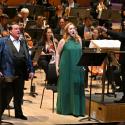
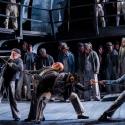
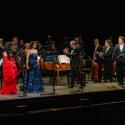
 You can see the logic behind the first half’s two contrasting Ariadnes – the distilled tragedy of Monteverdi’s solo lament and Strauss’s overflowing riot of a comedy – but the jolt from Elizabeth Kenny’s trio of theorbos to Wigglesworth’s suddenly gaudy orchestra was severe, with Graham failing to either collide or connect the two worlds visually. Strong performances from Will Pate’s agonised Music Master and Liam Bonthrone’s Dancing Master – all vocal ease and nimble delivery – supplied a foil to Johns’ intensity, with only Dhiarmada’s unusually contained Zerbinetta remaining a cipher in this colourful riot.