It’s Orfeo in the original Italian: not Monteverdi’s, nor yet another version of Gluck’s Orfeo ed Euridice, but a cornucopia of invention in the shape of the first Italian opera for the French court. When the Ensemble Correspondances presented its very much slimmed down version of a 13-hour “Ballet Royal de la nuit” for Louis XIV at the Chaise-Dieu Festival this August, it was the fragments of ravishing music from Luigi Rossi’s work which stood out among the six featured composers. Furnishing a finer line-up of soloists than the French group could muster, the Royal Opera’s second opera to be staged in the candlelit intimacy of the Sam Wanamaker was the complete vindication of Rossi.
It could have been a mess with lovely moments. Francesco Buti’s elaborate libretto throws in Venus, Cupid, the Graces, gossip-god Momus and a rival lover for Eurydice before the ill-fated maid dies at the end of Act Two. Director Keith Warner might have weighed down a production on a bigger stage with a cluttered concept as he had the Royal Opera Ring and Wozzeck. But in the helpfully limited stage space of the Wanamaker, he simply came up with something very lively and fluid, with adaptable tables and benches and stylish costumes from Nicky Shaw – more court of Charles II as befitted the venue than Louis XIV.
 If occasionally it was all a bit over-gestural, and the dances choreographed by Karl Alfred Schreiner didn't amount to much, we weren’t going to mind too much given a consummate cast, many not long out of music college – four of the women bright young stars from Australia, and the melting beauty of Christian Curnyn’s Early Opera Company Orchestra up in the gallery (a very warm welcome back to one of early music’s true heroes after too long an absence). And what opportunities Rossi gives them, including three great laments and a mad scene.
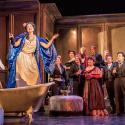
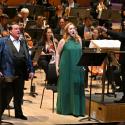
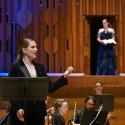
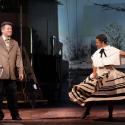
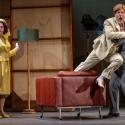
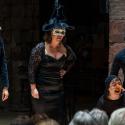
For once, we really care about Eurydice, who hangs around long enough to be the star of the opera’s first half, proclaiming energetically like Auden’s Anne Trulove, “If love be love, it will not falter”. Louise Alder (pictured in both images above), who most recently sang the maid Lucia in Fiona Shaw's production of The Rape of Lucretia, turns in an incandescent, richly coloured and urgent performance, which confirms her as the brightest lyric soprano of the younger generation (fresh from covering Sophie in Glyndebourne’s Der Rosenkavalier and singing the role at the Proms, she joined the ensemble of Frankfurt Opera and has already performed major roles there). Her passacaglia-aria and death scene would have been outstanding in any opera, any production; how consummately, too, she handled the dream sequence – hauntingly staged – and the tragicomic scene in which Euridice refuses to have the fatal snake venom sucked out of her by Venus-backed Aristaeus.
As that hapless would-be lover, Caitlin Hulcup showered warm mezzo riches on us at thrilling close quarters. Of the two original castrato roles, that of Orpheus is the higher, and should have been sung by Mary Bevan, swapping over from Eurydice in the Royal Opera's Monteverdi Orfeo. I don’t mean to disparage her known charms when I say that a throat infection which left her not singing but acting, very convincingly, gave us a chance to hear a new soprano of true individuality, Siobhan Stagg, delivering the part from above with stunning middle-range clarity and impeccable style (she’ll be vocalizing Orpheus for the next four performances).
 There were more ravishments from the ladies’ trio of Jette Parker Young Artists Lauren Fagan, Jennifer Davis and Emily Edmonds doubling the Graces and the Fates – the red rope cued links with Wagner’s Norns and Warner’s Ring, of course – who get the most individual number in the show at the beginning of Act Three, gone too soon.
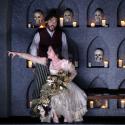
Character turns from fashion-model-esque Sky Ingram’s spiteful Venus, Keri Fuge’s plucky Cupid (the two pictured left), Graeme Broadbent outstandingly basso-profundo as Pluto and singular tenor Mark Milhofer’s Momus/Venus-as-old-woman, added to the rich mix. The ensemble numbers, above all the lamentations at the end of Act Two, provided another tingle-quotient at close quarters.
English translation was the right decision under the circumstances, and Christopher Cowell’s work was as witty as his definitive Ariadne on Naxos. It simply gave one more kick to the peerless musical credentials and direct communication of this winning entertainment, perhaps the best and certainly the most surprising of the Royal Opera's Orpheus offerings. If there were a CD of this company's Orpheus I'd buy it now.