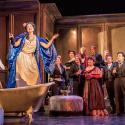
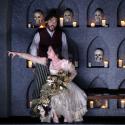
Debussy’s Pelléas et Mélisande is a drama played out in shadow. Shine too bright, too unyielding a directorial light on it, and the delicate dramatic fabric – all unspokens and unspeakables – frays into air. Just over a year ago, director David Edwards and the Philharmonia Orchestra gave us a semi-staging of exquisitely allusive simplicity, leaving the music to fill the gaps between symbol and emotion. Now it’s the turn of Peter Sellars and Simon Rattle – reuniting to stage the work that first brought them together in 1993.
And what a difference a decade (or two) makes. Where Rattle and Sellars’s Amsterdam Pelléas played out in a Malibu mansion, sexual rather than sensual – a realist put-down to the opera’s whimsical fairytale history – their new collaboration shares more with Sellars’s “ritualisations” of Bach’s Passions than his work for the opera house.
It’s storytelling of the most instinctive kind, its text picked out in gilded details
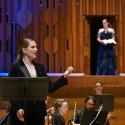
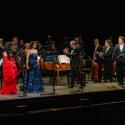
At the centre of it all, both musically and spatially, are the LSO. Fanning out across the entire width of the Barbican’s stage, they cradle the drama taking place amongst them. With violas and second violins taking the outer positions, closest to the audience, their hold is a deliberately soft one, cushioning the sharper, brighter, more pointed contributions of harp, oboe and first violins, and creating the finest of musical membranes around the sound.
Rattle’s relationship with this score is a long one, and it unfolds here in spontaneous, giddy arcs of acceleration that shudder into eddying pauses. It’s storytelling of the most instinctive kind, its text picked out in gilded detail by the musicians of the LSO. There’s a delicacy here, even to moments of extreme violence, that seems the musical echo of Sellars’s staging – a series of suggestions, implications, possibilities that rarely coalesces into anything approaching a statement.
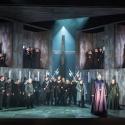
 Maeterlinck’s symbols – a tower, a cave, a lost ring – all retain their ambiguity, and only with his flock of sheep does Sellars slip into easy political assertion, as their “identity cards” are checked by a mobile-phone-clutching border-guard of a shepherd. Props are minimal. A black box placed centre-stage serves as tower, forest pool, bed and deathbed, allowing Mélisande to die among the violins, as the composer intended. At the back of the stage, a single chair allows Arkel to watch over the action, both threat and protector.
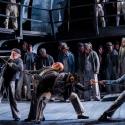
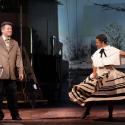
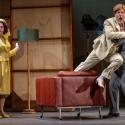
What’s most striking is the reaction of a director whose language is physical symbol, ordered, ritualised gesture, to a drama whose own symbols are already so clearly defined. Aided by an exceptional cast, Sellars’s style softens into a stylised naturalism, finding the human as well as the humane in the story. Even with the clutter of a symphony orchestra on stage, you’re always aware of Gerald Finley’s Golaud (pictured above with Elias Madler and Franz-Josef Selig). His hunting doesn’t stop at the end of the opening scene, but continues throughout as he stalks and prowls, dangerously obsessed with Magdalena Kožená’s Mélisande. This confusion of tenderness and violence is mirrored vocally. Such patrician smoothness and control, such tonal beauty becomes grotesque when allied to the bullying of his son (the astonishingly mature Elias Madler) or his physical abuse of his wife.
Nobody takes a vocal line for a walk quite like Christian Gerhaher, whose Pelléas is one unfolding legato gesture, a halo of bright harmonics brightening his baritone for this high-lying role. Together with Finley, however, and both the magnificent Franz-Josef Selig as Arkel and Kožená’s mezzo heroine, he pushes the musical centre of gravity down into a darker place. No vocal light makes it into this Allemonde.
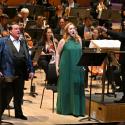
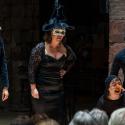
 There’s no denying that Mélisande is a role that suits Kožená (pictured left), making sense of the singer’s nervy series of performing ticks and sitting in a comfortable place vocally for this soprano-ish mezzo, but whether Kožená is the right performer for the role is less certain. Her Mélisande is no innocent. Instead of Maeterlinck’s vulnerable child we get a womanly seductress, fully in command of her two lovers. Compared to the interiority of Finley’s performance Kožená’s is positively cartoonish. Only the suggestion of real mental instability, that her Mélisande is aping a sexuality she has seen and learned, playing a role as best she can, saves the situation.
Sellars has described Pelléas as “the ultimate non-operatic opera – opera as real life”. But watching his characters move through a stylised lightsaber forest, loving and hating among the musicians of the LSO, what he has created is real-life as opera. There’s no banality here, no anchor in the everyday, just pure emotion and psychology elevated and intensified by so casual a staging. Its home may be the concert-hall, but Debussy’s work has rarely been more richly or satisfyingly operatic.
- A final performance of Pelléas et Mélisande takes place on 10 January