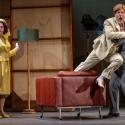
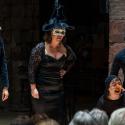
The pairing of Philip Glass and Franz Kafka is a natural one. A shared fascination with obsession, with developing a simple premise to its most densely worked-out, most logical conclusion is evident in both, and it is only perhaps surprising that it took until 2000 for Glass to produce In The Penal Colony. Exploiting the minimal surroundings of the Royal Opera House’s Linbury Theatre to maximal effect, this UK premiere production forgoes inference and suggestion in favour of all-out confrontation, etching its message brutally into the audience.
Adhering to the outlines of Kafka’s original story, Glass and librettist Rudolph Wurlitzer retain its claustrophobic, single-minded focus. A Visitor finds himself in the colonial penal colony of an unnamed state, invited by its Commander to observe the execution of The Condemned Man in the colony’s own uniquely sadistic manner. Acting as both judge and executioner is The Officer, a product of an old regime still delighting in the meticulous performance of his grim duties.
With forces comprising just a string quintet, two singers and an actor, this is Glass at his most austere – a dramatic contrast to the sprawling excess of Satyagraha or Einstein on the Beach. With these thinner textures comes a new focus on horizontal melodic lines, compensating for the loss of vertical, textural variation. Lyricism becomes the norm rather than the exception for the two voices; freed from their typical shackles of repetition and pattern they emote directly and evocatively – a bizarrely jarring effect in a work in which communication and humanity are so conspicuously lacking.
Michael Bennett’s high English tenor is an apt tool for the lyric passivity of The Visitor. Torn between moral obligation and social convention – “On my travels I have learned to respect each country’s customs, no matter how strange.” – he laments but fails to commit himself to his cause, eventually abandoning the island without a backward glance. Simplifying the original ending, Glass forgoes the final scene in which The Visitor physically prevents The Officer and The Condemned Man from joining him on the boat. It’s an omission whose loss materially changes the story’s effect, though whether intentionally it’s hard to tell.
A study in misguided orthodoxy, Kafka’s Officer is explicit in his fascination with the torture machine, whose harrow eventually takes its victims beyond pain and into a state of enlightenment. Omar Ebrahim sings resonantly (the decision to mike the singers is a necessary evil, though often obscuring diction), but his Officer remains something of a cipher, unclear as to whether it is madness, duty or desire that causes him to take such drastic action.
Encounters between Ebrahim and Bennett fail to ignite dramatically, but gain impact from the uncomprehending Dostoevskian presence and mesmerising silence of Gerald Tyler’s Condemned Man. Arching and straining on the table or innocently mimicking the gestures of The Officer, his is a performance whose aggressive intimacy (audience members were lined jury-like on either side of the stage) is almost unwatchably painful.
Playing from the back of the stage, the Music Theatre Wales Ensemble provides the driving force of the narrative. Attacking Glass’s inevitable ostinatos with energy that belies the difficulty of sustaining such thankless patterns, they provide a vivid aural parallel to the pulsing automata-like whirr of the machine. Glass’s decision to work and define himself primarily as a “theatre composer” still seems strikingly at odds with his style. Rejecting conventional theatrical arcs of tension and climax in favour of a single cumulative musical process, he creates musical waves whose patterns actively negate the idea of narrative climax or progression. Here they function well enough up until the story’s shift into overt allegory, where their inadequacy as a dramatic language becomes strikingly exposed.
Michael McCarthy’s production for Music Theatre Wales may initially seem a model of visual understatement, but is really just biding its time for shocking climactic impact, where it matches Kafka’s blunt prose blow for blow. What a shame that the music, blunt in quite another way, fails to leave room for the more allusive elements of the tale. In the hands of Glass and Wurlitzer a delicate fable comes perilously close to torture-porn.
With forces comprising just a string quintet, two singers and an actor, this is Glass at his most austere – a dramatic contrast to the sprawling excess of Satyagraha or Einstein on the Beach. With these thinner textures comes a new focus on horizontal melodic lines, compensating for the loss of vertical, textural variation. Lyricism becomes the norm rather than the exception for the two voices; freed from their typical shackles of repetition and pattern they emote directly and evocatively – a bizarrely jarring effect in a work in which communication and humanity are so conspicuously lacking.
Michael Bennett’s high English tenor is an apt tool for the lyric passivity of The Visitor. Torn between moral obligation and social convention – “On my travels I have learned to respect each country’s customs, no matter how strange.” – he laments but fails to commit himself to his cause, eventually abandoning the island without a backward glance. Simplifying the original ending, Glass forgoes the final scene in which The Visitor physically prevents The Officer and The Condemned Man from joining him on the boat. It’s an omission whose loss materially changes the story’s effect, though whether intentionally it’s hard to tell.
A study in misguided orthodoxy, Kafka’s Officer is explicit in his fascination with the torture machine, whose harrow eventually takes its victims beyond pain and into a state of enlightenment. Omar Ebrahim sings resonantly (the decision to mike the singers is a necessary evil, though often obscuring diction), but his Officer remains something of a cipher, unclear as to whether it is madness, duty or desire that causes him to take such drastic action.
Encounters between Ebrahim and Bennett fail to ignite dramatically, but gain impact from the uncomprehending Dostoevskian presence and mesmerising silence of Gerald Tyler’s Condemned Man. Arching and straining on the table or innocently mimicking the gestures of The Officer, his is a performance whose aggressive intimacy (audience members were lined jury-like on either side of the stage) is almost unwatchably painful.
Playing from the back of the stage, the Music Theatre Wales Ensemble provides the driving force of the narrative. Attacking Glass’s inevitable ostinatos with energy that belies the difficulty of sustaining such thankless patterns, they provide a vivid aural parallel to the pulsing automata-like whirr of the machine. Glass’s decision to work and define himself primarily as a “theatre composer” still seems strikingly at odds with his style. Rejecting conventional theatrical arcs of tension and climax in favour of a single cumulative musical process, he creates musical waves whose patterns actively negate the idea of narrative climax or progression. Here they function well enough up until the story’s shift into overt allegory, where their inadequacy as a dramatic language becomes strikingly exposed.
Michael McCarthy’s production for Music Theatre Wales may initially seem a model of visual understatement, but is really just biding its time for shocking climactic impact, where it matches Kafka’s blunt prose blow for blow. What a shame that the music, blunt in quite another way, fails to leave room for the more allusive elements of the tale. In the hands of Glass and Wurlitzer a delicate fable comes perilously close to torture-porn.
- In The Penal Colony is at the Linbury Studio Theatre until 18 September
- Find Philip Glass on Amazon
- Find Kafka on Amazon