“Charges that no court has made will be shouted at my head.” And so it proves. Benjamin Britten’s fisherman Peter Grimes is damned before a note is sung – condemned not by a judge, but by his own community. Deborah Warner’s brutal 2022 staging, now back at the Royal Opera for its first revival, never lets us forget this. We don’t even see a courtroom. Instead, the Prologue plays out as a hallucinatory fantasy, a fever-dream in the mind of Grimes himself: his dead apprentice haunts his thoughts, while a mob of dark figures circle like hounds. Grimes is a tragedy of alienation, but this staging is just as interested in the crowd as the outcast, and the effect is chilling.
A co-production with Madrid (which saw it first in 2021), this Grimes transferred to London the following year along with the majority of the cast. Now the same ensemble (give or take a niece or two) returns – testimony to a stellar line-up, certainly, but also a canny attempt to capitalise and build on collective energy and group dynamics now absolutely embedded in the large cast and chorus.
Conductor Jakub Hrůša is the new boy, and makes his mark in an account that plays interesting games with tension and release. The orchestral Interludes become the engine, enabling Hrusa to create sometimes unexpected expressive space within the scenes themselves. The effect takes a while to come good (Act I feels just a little sedate), but when it does, it has a wonderfully disorienting effect. The momentum baked into the score usually ensures a sense of inevitability; there’s no halting this storm. But more space, more musical push-pull, opens up the possibility of a different ending, tragedy averted.
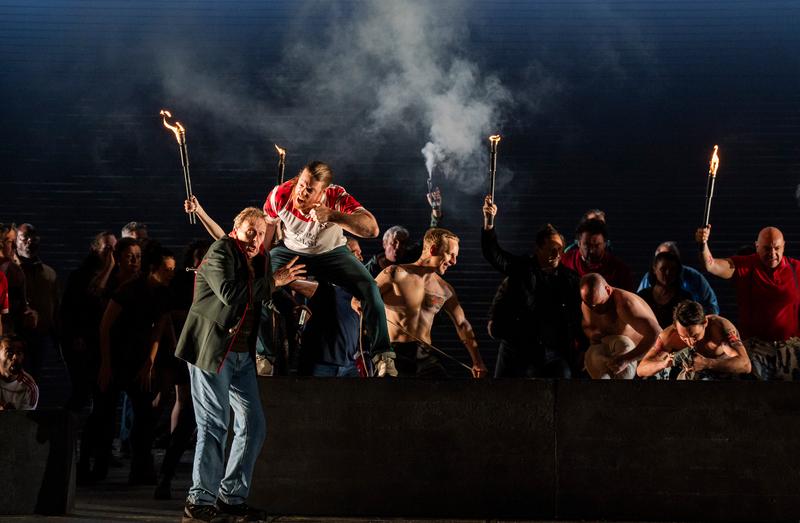
The climax, when it arrives, is almost unbearable. And not just because of the St-George’s-flag-waving, effigy-beating lynch-mob, but because the central trio – Maria Bengtsson’s Ellen Orford, Bryn Terfel’s Balstrode and Allan Clayton’s Grimes – have convinced us, despite everything, that it could be avoided.

This production was Clayton’s first; an astonishingly assured debut. Five years on the role has moulded even closer to his voice and body. With Clayton, you don’t have to choose between the English-song Grimes of Pears or Rolfe Johnson and the craggy power of a Vickers or Skelton; you get them both. The song-simplicity of “Now the Great Bear” and “In dreams I’ve built myself” meets the muscular power of the confrontations: his Sunday morning confrontation with Ellen, his mad-scene self-loathing. Terfel’s charisma is substantial, and it’s only Clayton’s own presence – cowed and erratic where Terfel’s sea-captain is easy and confident – that keeps the opera from becoming Balstrode. Well, that and an ensemble cast of dreams.

Who do you single out? Christine Rice’s curtain-twitching Mrs Sedley, her “Murder most foul” hissed venomously out into the furthest corner of the opera house? Or James Gilchrist’s fatally benign, fluting Reverend Horace Adams? Perhaps Clive Bayley’s grotesque Mr Swallow (nearly pantsed by Jennifer France’s sassy First Niece), or John Graham-Hall’s apoplectic Bob Boles. Maria Bengtsson’s Ellen is still vocally on the small side, but what we lose in weight and legato is gained back in the silvery beauty of the top of her voice. The quartet of women (completed by the exemplary Catherine Wyn-Rogers as Auntie, France and Natalia Labourdette as the Nieces) was a rare moment when Hrůša’s spacious approach didn’t quite work, its lovely cadences pinched rather than blooming.
Warner’s contemporary Borough is a thankless, graceless place of traffic-cones and plastic crates: the seaside of deprivation and forgotten people. The Royal Opera Chorus gives lusty voice to its disaffection and rage, darting shoal-like around Michael Levine’s steeply raked stage. Only in death does the staging give up its poetry. Aerialist Jack Horner returns at the close, now eddying and tumbling through the air as Grimes himself: a figure finally free and graceful, at last at one with his environment.