The opening gyrations of Thomas Adès’s bluesy, schmoozy overture to Powder Her Face beckon you into a world of cheap sensation and excess. Accordion, saxophones and sizzle cymbal add their indecent, after-hours suggestions, and you have a microcosm in moments. Almost 20 years on from its premiere, Adès’s opera about the scandalous “Dirty Duchess” still has all the moves. What a shame then that these are obscured in the baggy, cavernous space of English National Opera’s latest field-trip venue – the University of Westminster’s Ambika P3 concrete bunker.
Press notes might insist that the venue (used here for opera for the first time) is “intimate”, but I can’t work out whether it’s the exposed pipe-work or the towering, tiered rows of seating that is supposed to give this impression. Powder Her Face is a work that enjoys clandestine assignations in hotel rooms and private apartments – barely leaving the bed, let alone the bedroom, except for a shattering scene in court – and framed in this boomy, vertical space doesn’t give up its charms willingly.
Much of the opera’s off-the-cuff naughtiness is lost
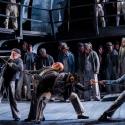
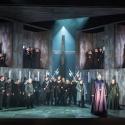
Director Joe Hill-Gibbins, making his opera debut, clearly has a plan. Seated in stiff, upright wooden rows, peering down on the action from above, it’s clear that we’re in the public galleries of a law court – voyeurs on the scandalous action playing out below. On paper it’s a clever device, forcing us into uneasy complicity with the journalists and photographers that hound the Duchess. Practically though it’s a problem.
Opera is never ideal in the traverse; you lose a lot of tone and almost all verbal clarity every time the singers turn around, and if (as here, bafflingly) there are no surtitles to help you then you might as well give up and enjoy the music. Adès’s colourful band is placed centrally, and although partially dulled by a helpful overhang, pretty much overwhelms all in its path. With a libretto as tight and witty and Philip Hensher’s this is close to criminal, and much of the opera’s off-the-cuff naughtiness is lost.
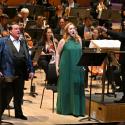
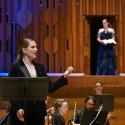
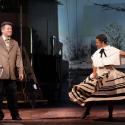
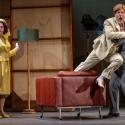
 Which is shame, because everything else here is pretty excellent. Alan Ewing’s extraordinary, flexible bass was made for the role of the Hotel Manager (who doubles as the Duke and, in a wonderful coup de theatre, the judge). Roaming from floated falsetto to the rumbling lowest registers, he (pictured right with Amanda Roocroft) comes into his own in the courtroom aria, torn musically between gruff, objective formality and wild personal rage. Ewing’s lurching shifts of mood were skilfully handled – a rare moment of abandon before the horrible control of his final encounter with the fading Duchess: “Your car is here. That is all, Madam.”
Amanda Roocroft makes a rare foray into this repertoire as the Duchess. Vocally it’s a impressive performance, giving her real stature and gravitas, and transforming the final scene into something almost Janáček-like - a tonal shift this impersonal space and Hill-Gibbins' alienation really does enhance. Directorially I question the decision to style her as old throughout. An opera that travels swiftly through time is tricky to manage, but a more obviously youthful, attractive Duchess at the start would make for a greater shock and contrast to her final desperate moments as an old woman, still clinging to long-faded attractions.
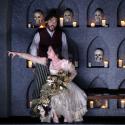
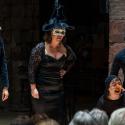
 Alexander Sprague (electrician) and Claire Eggington (maid, pictured left with Sprague) tackle Adès’s virtuoso vocal writing with easy skill. It’s a shame that Eggington’s high register collides so hard with this acoustic, obscuring much of the detail she and the forces around her are putting in, but there’s no doubting the blossoming loveliness of her Strauss-inspired moments of release. Sprague too sits happily at the extremes of his voice, and it would be wonderful to hear this young tenor with his agile, muscular instrument in the Coliseum itself again.
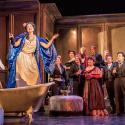
Ultz’s designs are stylish and perfectly too-much, from his neon-glowing portions of meat in aspic to a mauve bathtub, but it all lacks impact with the audience so far removed. When I wasm’t straining to hear the libretto or peering to see what was happening so far below I was yearning for the claustrophic intimacy and confrontations of Carlos Wagner’s 2008 production at the Linbury Studio Theatre. Up close and entirely too personal, that was a show that really got the (blow-)job done.
- Powder Her Face is at Ambika P3 until 19 April, 2014