Let's get straight to the fellatio, shall we. The blow job - and its Polaroid rendition - that led to the 1960s divorce trial of the dissolute Duchess of Argyll forms the centrepiece aria (an aria that "begins with words and ends with humming") in Thomas Adès's opera Powder Her Face. And how good we were: as silent as a row of Trappists. There was none of the outrage, laughter, consternation that this staged blowy could once summon up and that once led Classic FM to ban the work. Sex, when dealt with correctly - as in Carlos Wagner's revival production - is never really scandalous. It's awkward, poignant and, at times - Heaven forfend - actually kind of sexy.
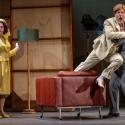
Silliness - though a serious, carefully observed silliness - is what we got for starters. Electrician and maid mock the sexual exploits of the Duchess, the handyman fake blow-jobbing a remote, the girl delivering a scored string of ha-has. From here, we slip and slide into and out of various episodes of the Duke and Duchess's lives: the Duchess's wedding day, her infidelities in a hotel room, her intemperate interview post-trial with a reporter, the Duke's infidelities with his mistress, the Duchess's bankruptcy.
The orthodox dramatic instinct, when faced with such privileged misbehaviour, indolence and lust, is to attack, attack, attack, to caustically kick out at the high-born immorality and decadence. But neither librettist Philip Hensher or Wagner play it quite like that. There is no assault on class, society, wealth or greed (though Hensher does attempt a moral bow tie in the penultimate scene and gives us the only weak moment of the night). Instead, what we get is a pretty believable depiction of the inside of the Duchess's head. The result is a psychological dream-play, perched between a seductive fantasy and grubby mundanity.
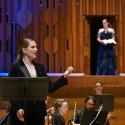
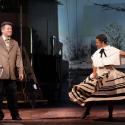
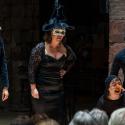
A dream-logic dictates proceedings. Rebecca Bottone - whose lustrous voice and body seemed to be able to do anything she wanted - is maid, then mistress, then journalist, then celebrity-gawper. Alan Ewing's Duke (apparently ill but in fine fettle when I heard him) is also the judge at the Duchess's trial. Her bit on the side is also the mocking electrician, Iain Paton - vocally a little worse for wear, though brilliant in the Cole Porter-like moments.
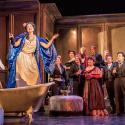
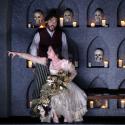
The set (Conor Murphy) gloried in a camp fantasy, with a pink Busby Berkeley staircase and an ingenious Claes Oldenburg giant compact bed on which the Duchess (the vocally terrific Joan Rodgers, who perhaps could have been a bit more bolshily shambolic) is sprawled most of the time. If there is a moral prod from Wagner and Hensher it is towards the hangers-on: the en-macked rubberneckers and dawdling gossips. The Duke and Duchess might be weird but the real immorality is pinned to the mackintoshes of us celebrity gawpers.
The dreamy, sluttish brilliance continues in the pit, where you will find some of the most enjoyable operatic writing of the last ten years. Hazy glimpses of Piazzolla, Ligeti, Berg, Mahler and Cole Porter flash past, red-lipped, feather-boa-ed, as if all at a tarts and vicars party. Underneath it all, there is the faint murmur of the English tradition and its moral clarion calls in the wheezy sounds of the accordion, which assumes organ-like moral purpose in a chamber setting.
This is not an opera attempting to be of massive consequence - yet, in so doing, becomes consequential. When the stupefied Duchess attempts to crawl up the Busby Berkeley pyramid, a music of Mahlerian excess, intoxication and self-pity appears, like a rain cloud, pregnant above us. This sudden change of musical tack (which, up until then, had mostly been anchored in Weil-like irreverance) is as much a comment on the rudderless excesses of late Romanticism as the Duchess's regression is a comment on the lost nature of 20th-century English nobility.
With a final vocal flourish from Rodgers, the two traditions (Romantic and noble) seem to go to the grave together. And, in a unexpected coda, a bold new orchestral palette is ushered in: the tinny taps and ticks of a number of percussive rims, a clean, expurgated world, so unnervingly small in sound, so subtly conclusive in concept, so welcome, so right, so Adès.
- Powder Her Face is at the Royal Opera's Linbury Studios until 10 May
- Check out what's on at the Royal Opera this season and in 2010-11