How much familial dysfunction and lust - whether for sexual gratification or revenge - can one take in a single weekend? Salome and Elektra back-to back may on paper seem like a feast of divine decadence but no sooner had one become accustomed to the sickly sweet air of the former when the putrefaction of the latter (I always think that Strauss’ orchestra is in the final stages of decay with Elektra) filled one’s nostrils - and ears. Then there was the little matter of inevitable comparisons, of Salome - with Stemme, Runnicles and his fabulous Deutsche Oper Berlin Orchestra - being one of the best live performances of the piece it has ever been my good fortune to hear. Follow that? Not even close.
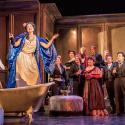
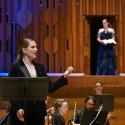
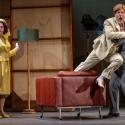
 When Semyon Bychkov (pictured left with Miranda Keys' Overseer and maids) conducted Elektra at Covent Garden some years back I don’t remember it feeling so heavy, so deliberate, so slow. It could be that removed from the theatre and with an orchestra - the BBC Symphony - less familiar with the piece than their counterparts at the Royal Opera House that an element of caution, of safety first, pervaded this performance. Of course, the BBC Symphony play unfamiliar repertoire all the time and the playing was certainly of a quality, occasionally blazing to life in climactic releases and more notably outstanding in that sombre portent of revenge in Wagner tubas and trombones when Orestes effectively comes back from the dead. But the unfamiliarity was still apparent to me; there wasn’t that bedrock of security in the playing. And when it came to a scene like the baiting of Aegisthus with its pre-Rosenkavalier parody of waltzy titillation the joke didn’t land on account that the schmaltz wasn’t well and truly under the fingers of the fiddle players. More worrying still was a lack of inner tension and dramatic momentum so that when the great Recognition Scene finally arrived it seemed to come from nowhere.
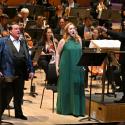
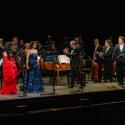
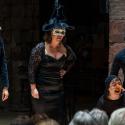
 For certain it wasn’t moving as it surely must be and is - not because of the Orestes (Johan Reuter brought a still, quiet, almost ghostly dignity to the role) but because the Elektra, the much-lauded Christine Goerke (pictured right), didn’t sing a single phrase below mezzo forte. Nor did the words come from within, or indeed off the page. Without the text in front of me they all blurred into a kind of one-colour-fits-all generality. Goerke’s middle voice is big and exciting and at the start of her monologue the invocation to “Agamemnon! Father!” resonated with wonderful gravitas from the sound alone. But as the voice moves into the upper quadrant - especially with those top Bs and Cs - it narrows and loses its quality and girth. Goerke is now the darling of the New York Met - and judging by her delirious reception here of the Proms audience too - and it’s a fact that everybody thrills to big and loud, but since her appearance in the role at the Royal Opera House last year more wear and tear is plainly evident. If you sing these roles like this, they take their toll.
Gun-Brit Barkmin as sister Chrysothemis doesn’t have that kind of vocal equipment - indeed in this hall she was really over-parted in the role - but from her I did get the text and the longing and the yearning for a life not yet lived - and though the singing wasn’t pretty and somewhat pushed in her big moments it really came from somewhere. Too bad that she and her sister were subjected to such silly and inappropriate prancing in their short-lived moment of triumph
 The evening, though, did deliver one masterclass in vivid text and electrifying (sorry) vocal characterisation - and that was Felicity Palmer’s seasoned and scarifying Clytemnestra (pictured second from left with Reuter, Barkmin and Goerke). Every moment of her great scene - Hofmannsthal’s libretto at its purplest and richest - was her recurrent nightmare relived, the words rattling and rasping to blood-curdling effect. As she asked the question “Can one then perish while still alive, like a rotting carcass?” she was, in this performance, effectively answering it.
But would that every scene had had the accumulative power of that one. Elektra should be gripping from first note to last; but this performance relied on its climaxes and much too much screaming to pummel us into submission. Too much hot air, not enough of its dark soul.