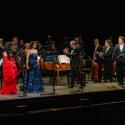
With French baroque opera all but banished from the UK’s major opera companies, it’s left to concert halls and country houses to fill the void. There’s a full-length treat ahead this summer with Rameau’s opéra-ballet Les Indes Galantes at Hampshire’s Grange Festival, but first Temple Music served up an amuse-bouche from Christian Curnyn and his Early Opera Company.
Before there was George Bernard Shaw (or My Fair Lady, for that matter) there was Rameau’s take on the myth of Pygmalion – the artist so in love with his own creation that she comes to life. The composer’s one-act opera is the perfect mouthful of a genre English audiences still treat with suspicion: a drama-in-miniature framed in some of the composer’s loveliest dance-music.
For so compact a drama (just four characters, including the Statue) the emotional stakes are surprisingly high, largely owing to an extraordinarily virtuosic sequence of arias and ariosos for Pygmalion himself (a high-stakes, high-wire role for haute-contre) starting with “Fatal Amour!” and finishing with “Régne Amour”. Any performance stands or falls with Pygmalion, and here it wobbled a little.
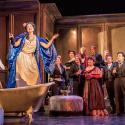
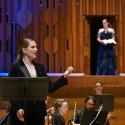
British tenor Samuel Boden has a sweet, flexible instrument that floats easily above the stave, capable of wriggling dextrously through even the densest thicket of semiquavers. But this wasn’t the best night for singer, visibly and audibly tense. Balance in Middle Temple Hall is a tricky affair, but strings frequently overpowered Boden, happiest in the knotty emotion of the initial languishing than the later celebration of Love’s power. “Régne Amour” never quite found the brilliance or power this unapologetic display of vocal pyrotechnics demands. 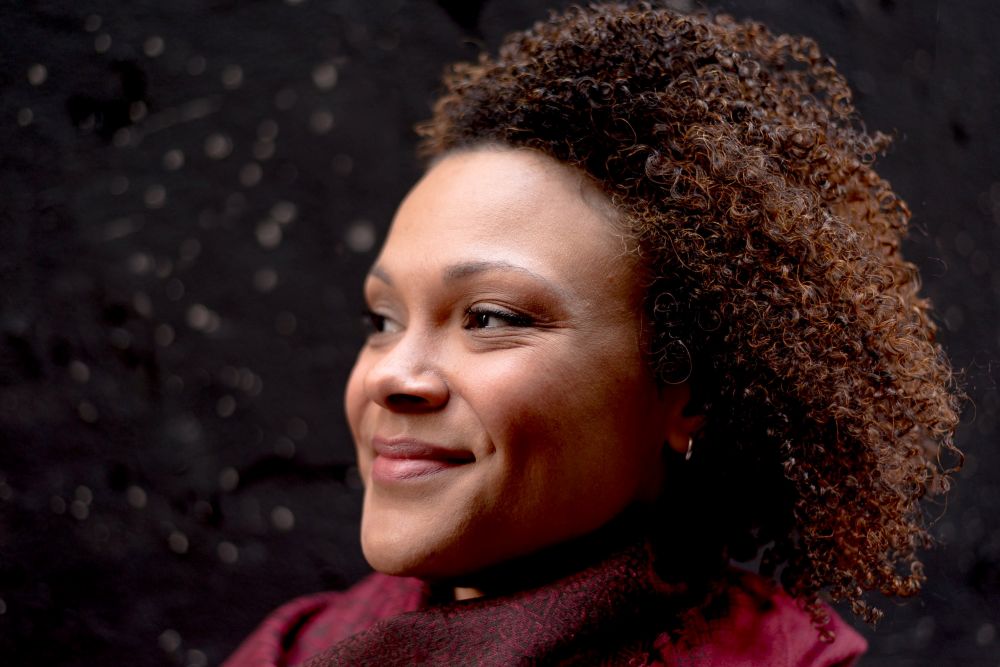 Rising sopranos Jessica Cale and Lauren Lodge-Campbell did lively battle as love-rivals Céphise (Pygmalion’s neglected girlfriend) and the Statue – Cale’s warmer, fuller voice a foil to Lodge-Campbell’s silvery clarity. But Rachel Redmond’s charismatic Amour, fizzing with mischievous energy, took the laurels. “Jeux es Ris” sparkled and danced, eddying on the currents of strings and woodwind, at one with Curnyn’s ensemble (Redmond pictured above by Chris Wallace).
At the centre of the opera is a sequence of dances. Amour summons the Graces, who instruct the Statue in movement, sliding gracefully from mood to mood. Both here and in the preceding transformation scene, with its ravishing musical metamorphosis, the orchestra is in the spotlight. Curnyn’s rhythms were all groove and snap, from pomp to languor and back in an instant, his band alert and responsive, iridescent with shifting colours. The opera’s closing pair of dances: the lovely “Air gracieux” and the rollicking “Contredanse” (gilded with tambourine) sent us out in style.
Things were less in focus in the orchestral suite from Les Boréades. The concert’s colourful opener took time to settle, feeling under-rehearsed. Balance and tuning weren’t helped by the space, knocked off kilter occasionally by the glorious rusticity of Ursula Paludan Monberg and Peter Moutoussis’s horns – full-throttle in Rameau’s filmic “Suite des vents”, aided and abetted by Scott Bywater’s percussion.
This is music with no need for staging: Rameau does it all in the score. The opera house’s loss is the concert hall’s gain, and with advocacy of Curnyn and the like hopefully we’ll get the chance to hear more of these glorious works.