Watching and hearing this revival of WNO’s now eight-year-old production of Verdi’s Rigoletto, it’s hard to remember he composed it only a year or two before La Traviata, that most psychologically believable of all his operas. In Rigoletto nothing makes sense: the hunchback’s pretty daughter, her apparently willing incarceration, Rigoletto’s hoodwinking (literally) into helping her abduction, her final self-sacrifice – all palpable nonsense. Yet the piece never seriously fails. In a sense it’s music drama at its purest: the plot is an appendage to the music, what Wagner later called “deeds of music made visible”. So you might expect it to work in any setting, as long as the music is properly treated. James Macdonald’s production, revived with a very strong cast under a fine conductor, suggests not.
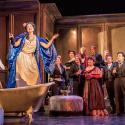
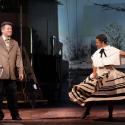
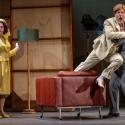
Macdonald and his designer, Robert Innes Hopkins, famously transplant Victor Hugo’s story to Kennedy’s White House – one of those bright after-dinner ideas that too often hit the stage when they should really have gone out with the left-overs. The change adds stupidity to the nonsense. At least in 16th-century Mantua it’s half-plausible that Rigoletto would be disturbed by Monterone’s curse. But in 1963 Washington (in fact November, to judge from the illuminated pumpkin head in Rigoletto’s house)?
And who is this Rigoletto anyway? And who are all these ridiculous balding, besuited courtiers, dedicated apparently to nothing except kidnap and rape? One may be a Kennedy agnostic, but surely there are limits. In short, the attempt at veracity merely draws attention to the improbabilities, and – worse – renders them irritating. Luckily, though, WNO base their casting on sounder principles. Rigoletto is an easier work than its other Verdi contemporary Il Trovatore, which according to Caruso needed the four greatest singers in the world in order to be a success; Rigoletto needs only three, though it adds some tricky and subtle supporting roles, like the unforgettable bass part of the contract killer Sparafucile, superbly sung here by the up-and-coming David Soar, and the briefer but not much less important Monterone (Michael Druiett, also impressive).
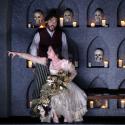
The Duke (President) of course has the juiciest lollipops, and WNO were fortunate to have Shaun Dixon as reserve for the indisposed Gwyn Hughes Jones, singing with complete aplomb and immaculate style, including a few bad habits of your well-versed Italian tenor (not, for example, quite reaching his standard-issue top B at the end of "La donna è mobile"). Dixon also has excellent presence and is a better actor than most spaghetti regulars.
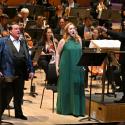
The vocal star of this particular show, however, is beyond question the American soprano, Sarah Coburn, whose vulnerable, bobby-soxed Gilda fits the production to a tee, but whose musical command makes no concessions to its brainlessness. Her "Caro nome", supported by exquisite flute-playing, should have stopped the show but didn’t, quite, because Verdi (thinking of stage rather than audience values) fades it out at the end, so that only Italians, perhaps, know that you should still cheer such singing to the rafters, if necessary drowning the orchestra. She is also deeply touching in the post-rape scene – "Tutte le feste" perfectly balanced in sentiment, controlled in vocal line.
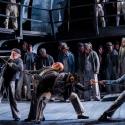
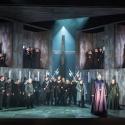
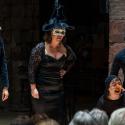
By comparison, Simon Keenlyside (pictured above right with the WNO Chorus) is not in my book as one of the angels of the voice, but he uses his slightly colourless timbre to brilliant effect, and at times almost convinces us that the Hunchback (or at least Handicapped) of Capitol Hill is a possible concept. His "Cortigiani" rises to an almost frightening grandeur of menace, and he earlier manages the switch from tormentor to tormented as convincingly as one can expect in this context.
The conductor is the young Spaniard Pablo Heras-Casado – excellent not least because unobtrusive, attentive to the singers but also moulding orchestral and choral detail with great care. And this company is in fine fettle just now, apparently unjaded by their more spectacular work on Wagner’s Meistersinger.
- Rigoletto at the Wales Millennium Centre on 28 June and 2 July, and the Birmingham Hippodrome on 7 and 9 July