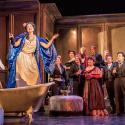
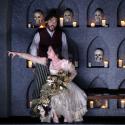
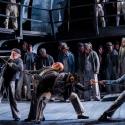
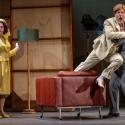
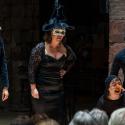
A thousand miles away from the Disney version, the transformation scene in Dvořák’s Rusalka is bleak and terrifying. With not a cauldron, bat or cobweb to be seen, the heroine is strapped to an operating table before imbibing the witch’s magic potion intravenously. Then her legs, until now swaddled together, are literally torn apart. It’s a brutal, shocking moment; no surprise that some audience members giggled nervously. Opera North have revived Olivia Fuchs’s 2003 production with the superb Giselle Allen reprising the title role and it still packs a punch; the staging successfully transcends the work’s longueurs through good acting, simple, stark set design and idiomatic musical direction.
First performed in Prague in 1901, Jaroslav Kvapil’s libretto is a fairytale heavily indebted to Hans Christian Andersen’s The Little Mermaid. Water nymph Rusalka falls in love with a prince and goes to see Ježiba the witch, who can make her human if she agrees to sacrifice her voice. Another condition is that Rusalka will become cursed to spend eternity between earth and water if her love is rejected. Naturally, her relationship with the Prince does not go to plan and as he begins to be attracted to a glamorous foreign princess, Rusalka’s plans unravel tragically.
Dvořák’s score is a thing of wonder, its bohemian folksiness offset with moments of post-Wagnerian harmonic daring. Rusalka’s desperate urge to experience love as a human is so longingly, vividly expressed that we worry about her losing her innocence, and the dark, chromatic wind writing during the scenes with Ježiba suggests that Dvořák knew what the subtext was. A fundamental plot problem is that we now have a central character in an opera who is effectively mute, but Dvořák is able to cannily bend the rules later on in the work.
Giselle Allen looks perfect in the role, and during the scenes when she is silent her careful physicality beautifully suggests desire. The closing moments in Act One, where Richard Berkeley-Steele’s Prince meets Rusalka and whisks her off to his palace, are gloriously heartbreaking: we expect a full-blooded love duet but only hear one voice. There’s fun to be had in contrasting Allen’s physical demeanour with that of the guests and courtiers in the Act Two palace scenes, their stiffly choreographed dance movements contrasting with Rusalka’s natural joy at being able to use her legs for the first time. Niki Turner’s design adds to the chilly formal aura through the use of several large blocks of ice.
The supporting cast are excellent, with Richard Angas conveying resignation, pain and sorrow as Rusalka’s father, and Anne-Marie Owens an appropriately sinister witch, all lab-coated officiousness. Oliver von Dohnányi conducts with affection and skill; every tiny pause, every touch of rubato sounding completely natural. Maybe the orchestra enjoy themselves a little too much during Dvořák’s heavier tuttis, but the sound is completely right for the work. And the harp and woodwind accompaniment during the opera’s one hit, "The Song to the Moon", is ravishing.
- Rusalka is at the Grand Theatre, Leeds, and then on tour