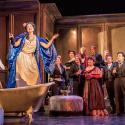
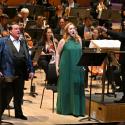
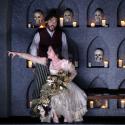
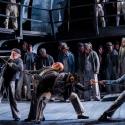
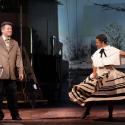
From “Printemps qui Commence“ (spring is beginning) to “Springtime for Hitler"... that really is quite some intellectual leap. Patrick Mason, an experienced and respected opera director, has uprooted the tale of Saint-Saëns's opera from biblical Gaza, and has placed the first two acts in France somewhere around the time of Jean Renoir's La Grande Illusion, with Warsaw ghetto overtones.
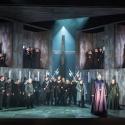
He has then clearly transported the third act in the mid-to-late thirties, and laden those final scenes with overt references to the rise of the Nazis, complete with leadership cult, book-burning and the Hitlergruß. To support this political narrative, the word 'Prêtre' (priest) gets cunningly switched in the surtitles to "Minister". The final gratuitous deed then seems to land the action in the present day. Samson's destruction of the temple (spoiler alert) has him as a suicide bomber, defiantly brandishing sticks of explosive with which he will bring the edifice down.
Grange Park Opera does have a continuing and, in the main, a highly successful tradition of bringing the French opera repertoire to life. It has gone with radical updatings before – from 2008, a crazily joyous Offenbach Barbe-Bleue, with harpoon-carrying deep-sea divers stand outs in particular. But this production of Samson et Dalila seemed to leave many questions unanswered. The original Bible-based story is well known, and on a first viewing, the emotionally charged material from another felt extraneous.
 These flaws in the conception was a disappointment, because musically, and with Gianluca Marcianò conducting, there was so much that felt completely right. The momentum of the musical action never flagged, and Marcianò was putting the case for a piece that is far more characterful, integrated, beautifully crafted and worthwhile than the reputation which precedes it. For a first night, we were on very firm musical footing indeed.
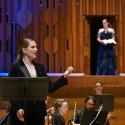
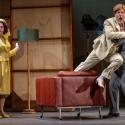
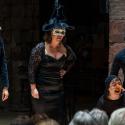
Mason has also enabled the individual characters of the three principals to be very convincingly drawn. The American tenor Carl Tanner (pictured above), who has previously sung both the title role in Peter Grimes and Herman in The Queen of Spades at Grange Park, was in good voice and gave a strong account of Samson. Dalila is Sara Fulgoni's ninth role at the Hampshire opera house, and she was the characterful, knowing and experienced of his demise (pictured below right). Brazilian baritone Michel de Souza was a vocally commanding and convincing High Priest of Dagon.
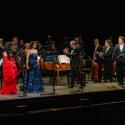
No praise can be too high for the work that Marcianò and repetiteur Patrick Milne have done with the chorus. They were remarkable throughout for their consistently bright, focused and balanced singing. In the intimate acoustic of Grange Park's theatre, you can feel that chorus sound as it hits you.
 There was a constant flow of musical revelations from Saint-Saëns's score. The held-chord writing for the woodwind section is demanding – but the Bournemouth Symphony Orchestra's players rose to the challenge as one, giving the music all of the bloom, the clarity and the precision it required.
A performance like this serves as a reminder that Saint-Saëns's reputation is rising. His sheer facility and expertise as composer, and the breadth of what he achieved are becoming better understood. Beyond his music, he was also an organist, a poet, and an erudite critic who wrote with robustness, elegance and clarity. A good recording of Les Barbares has just been issued. Advocacy from the distnguished 19th-century music specialist Hugh McDonald is likely to result in a book in the near future about all 12 of the French composer's operas.
Grange Park has its compensations. It is, as ever, a magical and charming place to be, even on a day when the sky is full of dark clouds – but the production doesn't quite add up.