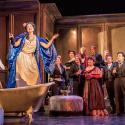
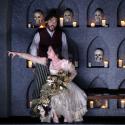
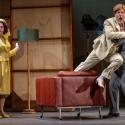
There was a moment half-way through Jonathan Dove’s children’s opera Swanhunter when I suddenly realised why pantomime developed its convention of the principal boy. Having a grown man prancing and posturing boyishly for the entertainment of a room full of kids feels odd, affected somehow, distorting the simplicity and sincerity of the tale being told. Which is a shame when, as here, the theatrical trappings are so vivid and enticing.
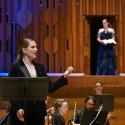
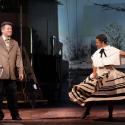
Premiered by Opera North in 2009, Swanhunter is now – in a rare vote of confidence for a new work – getting a second outing from the company, in a fresh touring co-production with The Wrong Crowd, directed by Hannah Mulder. Mulder supplements the cast of six with a stylish collections of puppets – think less The Sooty Show and more War Horse or Japanese Bunraku – which help bring the more fantastical elements of this Finnish legend to life.
Jonathan Dove’s score is a gorgeous musical mongrel, taking its soundworld from Baltic folk music
The story is simple (give or take a little wizardy and some dismemberment). Lemminkäinen is a charming young thug determined to “catch” a wife. For reasons that are unclear, the only candidates he’ll consider come from the North, so armed with his Ladybird Guide to Women he leaves his mother behind and sets off. But there are conditions to acquiring these North Women, and Lemminkäinen must complete a series of impossible tasks before one may be his. Falling at the final hurdle, he is killed and dismembered (very tastefully) by Death, before the song of his mother magically restores him to life and health. Whether he ever gets the girl or not, however, remains tantalisingly unknown.
Using just six instruments, Jonathan Dove’s score is a gorgeous musical mongrel, taking its soundworld from Baltic folk music, captured in accordion and fiddle-style violin playing, but adding the rhythmic impetus of a drum-kit, some gravitas with a horn, and a strong kick of jazz from the double bass. When the narrative threatens to sag, the score’s propulsive energy and character – developed in a series of recurring motifs – step in to support. The vocal writing is distinctive and effective, using a quartet of campers as a vocal backdrop for the virtuosic outpourings of both Mother (Ann Taylor, in glorious voice, carving through Dove’s richly textured vocal lines) and Lemminkäinen (a poised Adrian Dywer) himself.
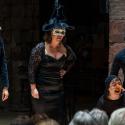
 The quartet of campers all step forward in turn as soloists, taking on the roles of Lemminkäinen’s various foes. There’s strong work from Matthew Hargreaves and Christopher Diffey, and Rebecca Afonwy-Jones makes a wonderfully imperious and rich-toned Louhi. But it’s Suzanne Shakespeare’s Swan that stands apart, gifted with an extraordinary vocalise of an aria by Dove, soaring higher above the stave than any Swan ever managed with complete control and purity of tone.
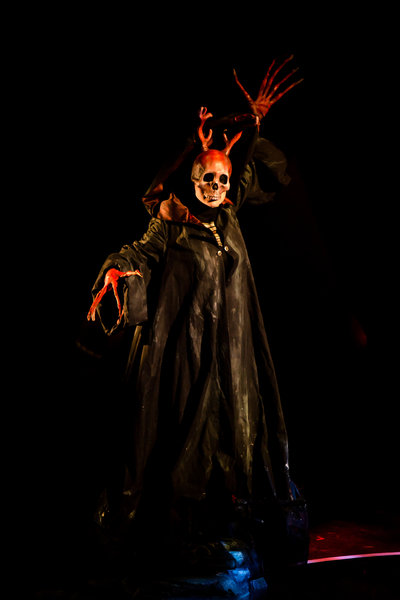
Canning’s puppets, however, are the stars here. Her Devil’s horse pacing and prancing with real force, and Death himself a menacing, long-fingered creature. There’s an analogue charm to this production that deliberately defies any expectations of a digital age, proving that children don’t need complexity to be utterly absorbed. The young audience members at this polished performance – a dress-rehearsal in all but name, thanks to issues caused by the Holborn fire – all seemed entranced.
As an adult I wasn’t quite as convinced, troubled by the rather lofty quality of Alasdair Middleton’s libretto, which doesn’t give an inch in its treatment of such unfamiliar material (this is definitely a production for children over 10), and by a lack of satisfying arc to a drama that ends in mid-air. But the score is a delight, working all the magic needed.