If nothing else, Stephen Sondheim’s best-known work will put you off pies; it will put you off barbers; and it may in the end put you off Sondheim. Popular though it seems to be with planners and programmers, it’s sluggish and heavy going as drama and thin gruel as music: three hours of clever musical patter, repetitive orchestral mechanisms, and slinky variations on the “Dies irae”. When you’ve seen one throat-slitting, one human pie-bake, you’ve seen them all. And when you’ve heard the Ballad at the start of Act 1 and the waltz at the end of it (“A little priest”), you’ve heard most of what’s worth hearing in Sweeney Todd.
I daresay this is too harsh a judgement on a composer who, Wagner-like but more catchily, writes his own brilliant lyrics, and has created a highly recognisable and effective semi-popular style somewhere between Cole Porter and Philip Glass. At his best Sondheim is distinctive, tuneful and memorable. But the stretch is too great, and well before the final corpse-scattered scene in James Brining’s new production for WNO I was shuffling my programme, glancing at my watch, and thinking about a vegetarian supper.
Maybe the problem lies partly in the way an opera-house deals with musicals: no star performances, no spotlights (except here and there discreetly for chorus members), no drum-rolls. Perhaps also not enough cuts. The only concession to commercial habits is that the singers are miked; but not well enough to compensate for the tendency to sing down when you think the mike is doing the projection for you.
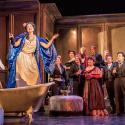
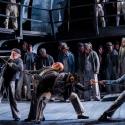
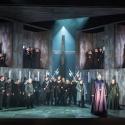
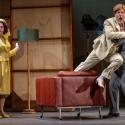
moments of excellent black comedy, if inclined to wear thin after the umpteenth murderRightly, the production takes the work seriously and invites it to stand on its merits. It updates it a hundred years or so, but not distractingly or modishly. Colin Richmond’s single, wittily atmospheric set serves the piece well, with its basic London street and cutaway upstairs bedroom and barber’s saloon, from which Sweeney disposes of his customers down a chute that ends next to the baking oven. These are moments of excellent black comedy, if inclined to wear thin after the umpteenth murder. And Mrs.Lovett’s drawing-room furniture, straight from MFI, is a nice image of petit-bourgeois done-well-for-herself, thanks to the corpse pies.
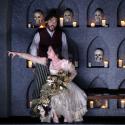
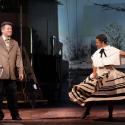
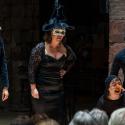
 Janis Kelly (pictured right with David Arnsberger and pie) catches this image with precision, from the slatternly but twinkly purveyor of “The worst pies in London” to the not wholly passive recipient of Tobias’s affection in “Not while I’m around”. And her vocalising – soprano when required – is consistently stylish and to the point. But, within that idiom, the cast has no particular weakness, if no overpowering strength.
David Arnsperger could be a more diabolical, perhaps noisier Sweeney, but gets the flavour of outraged sentiment taking drastic, sometimes unintentional revenge on its objects. George Ure is excellent as Tobias, in his one big number, but also as front man for the mountebank Pirelli (Paul Charles Clarke). Jamie Muscato is a likeable, if not specially fluent Anthony, Soraya Mafi a sweet, deliquescent Johanna, and there’s a touching vignette of her mother, reduced to penury, by Charlotte Page. Steven Page and Aled Hall, finally, are excellent as the corrupt Judge and his sidekick. Both end up coffined in pastry.
James Holmes conducts, efficiently enough, though with a few problems of rhythm and ensemble not yet entirely solved. The WNO orchestra has been put through its paces these past weeks: Bellini, followed by Handel, followed by Sondheim. Their tolerance is obviously as strong as their versatility.
- Further performances of Sweeney Todd at Wales Millennium Centre tonight, then daily 24-29 November, meanwhile on tour