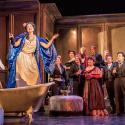
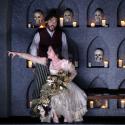
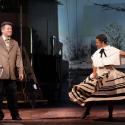
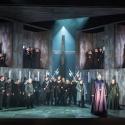
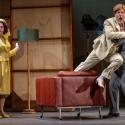
Tim Albery’s 2010 production of Wagner's Tannhäuser is back for a revival at Royal Opera, featuring a different conductor and a nearly new cast, with one notable exception. The production itself is serviceable, visually coherent and with plenty of atmosphere. The sets, by Michael Levine begin with a replica of the Covent Garden proscenium arch in the Venusberg scene, which is then shown in progressive states of decay in the following acts. The Venusberg choreography, by Jasmin Vardimon, is modern and slick, as dynamic as it is sensual.
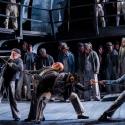
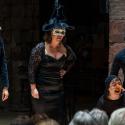
The drama that follows is much more static, however, with brief moments of illuminating Personenregie, particularly in the song contest. Costumes, by Jon Morrell, are a mix of new and old, mostly in drab colours, with the crowd in the song contest incongruously dressed as Kalashnikov-toting guerrillas. Disparate ideas, but they all fit together, in a production that for this revival proves a good vehicle for a close to ideal cast in the major roles.
Tempos are generally fast and phrasing is clipped and precise
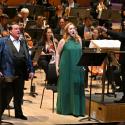
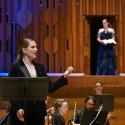
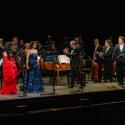
Conductor Hartmut Haenchen can’t match the effortless breadth and fluency that Semyon Bychkov brought to the production on its first run – who could? But nor does he try: Haenchen’s approach is slicker, less opulent but more dynamic. Tempos are generally fast – the performance ended 20 minutes earlier than advertised – and phrasing is clipped and precise. Some of the more lyrical passages loose out under Haenchen’s baton, particularly the Pilgrim’s Chorus, which never fully blooms. But Haenchen has a good sense for the progression through Wagner's music, always elegantly shaping the drama. Sometimes he leaves the singers behind, though: his fast pace in the Act II “Landgraf Hermann, Heil!” almost lost the chorus, and Hermann himself (Stephen Milling) lagged behind in the following narration. First night woes only, one hopes.
The 2010 cast was impressive (Johan Botha, Eva-Maria Westbroek, Michaela Schuster), but the singers assembled for this revival are even more so, particularly for their suitability to their respective roles. Sophie Koch is an alluring Venus, with a rich, silky tone. Her diction is poor though, with barely a word audible. Peter Seiffert is a fine Tannhäuser, with a powerful, commanding tone and richly expressive delivery. He had some problems with the louder passages on the first night, particularly in the Rome narrative, where his voice often broke off on high-phrase endings. But in the quieter music, particularly in the second act, his characterisation was excellent, Tannhäuser's increasing sense of guilt and remorse powerfully portrayed through Seiffert’s increasingly anguished utterances. Emma Bell has a suitably pure tone for Elisabeth: her voice is a little narrow in the louder music, but it is just about big enough for the role, and she too acts as convincingly as she sings. Stephen Milling’s Herrmann was the best of the supporting roles, his tone smooth, even and well projected. But best of all was Christian Gerhaher as Wolfram (pictured above). It’s his signature role, which he first sang at the Royal Opera in 2010, and Covent Garden is one of the many houses around the world where it is now almost impossible to imagine anybody else singing it. Gerhaher is first and foremost a recitalist, and he has previously performed Wolfram in that spirit, coming on, singing and then leaving again. But there is more characterisation in his performance now, more interaction, with Elisabeth in Act II and with Tannhäuser in Act III. Vocally, he is as fine as ever, with a distinctive timbre that can effortlessly carry across any texture, the colour simultaneously warm and complex. Last time round he completely stole the show. This time he’s in a stronger cast, but he’s still the main draw.