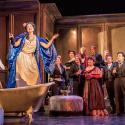
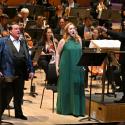
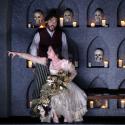
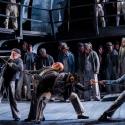
Travelling by Eurostar, or plane, to the continent and buying a ticket, all for less than the cost of a Covent Garden stalls seat, might entice if you wanted to see a certain opera, singer or conductor. But to go so far for the look of a staging? Well, the Catalan company La Fura dels Baus’s phantasmagorical ENO production of Ligeti's Le grand macabre has left some of us hungry for more, which so far means going abroad to find it. Ultimately their latest Wagner doesn't always rise to the expected visionary heights, but it does boast world-class music-making and, wonder of wonders, real interaction between the singers on a human scale.
This is the more surprising as I’d envisaged one of those productions where the visuals do the work while two heffalump lovers stand or sit to one side, a bit like Bill Viola’s compensatory films last seen in a Festival Hall semi-staging. But the dearth of great Tristans and Isoldes who can move as well as stay the course of the toughest sings in the repertoire seems to be at an end. Lyon fields two you'd be happy to see on any stage in the world, and Furanian master-director Àlex Ollé uses them with an intelligence, and an awareness of this house's relative intimacy, I've never encountered in this of all operas.
Isolde is the Danish soprano Ann Petersen: statuesque, fiery, sympathetic, as tender in love as she is steely in wrath. At first you fear that the inevitable big vibrato is going to get in the way, which it only does when the longest lines need to be spun. But so intelligently is Petersen encouraged to point the text, so often is she allowed to sing softly, that you melt when she doesn't make you tremble with fear. And here is one of the stage picture's greatest complicities with the acting, chiefly by virtue of Alfons Florès's design for the wooden platform which serves as the Act I ship carrying Isolde unwillingly from Ireland to Cornwall against a sea that veers between boiling and eerie calm.
 Just as you're hardly aware of Wagner's score moving through space, once past Kirill Petrenko's infinitely string-caressing interpretation of the Prelude, so it's only some way in that you realise the platform is revolving until its sharp corners hang over the orchestra. And it's at this point that Isolde moves right to the edge to deliver her terrifying curse of wronged womanhood, arm flung out directly at the audience.
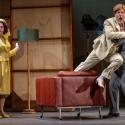
This is great theatre. So is the way the pendulous subdivided sun-disc descends and becomes, thanks to Franc Aleu's always surprising video projections, a cratered moon (pictured above) for the long-anticipated confrontation between the loving enemies before the potion unleashes what's latent between the two. Clifton Forbis doesn't move quite so freely as Petersen, but his Tristan is so obviously right, from its baritonal foundations to the tirelessly ringing top, that we know we're in for a great third act in which the tenor doesn't die before his character's supposed to.
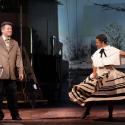
 The second doesn't quite hit the promised heights. The lovers (pictured left) go through forests, fire, cloudscapes, water and disintegration via projections on the Cornish castle as suggested by the inside of the disc, now egg-shaped. Petrenko, having paced and enlivened the shipboard act beyond the ken of any conductor I've heard, is perhaps a bit too controlled to go with the incandescent ebb and flow of Wagner's greatest music, and Aleu's pictures don't quite hold the magic when, in contrast, the characters have to be accompanied around the stage by old-fashioned follow spots. But there's heartbreak in the way this pair hold each other, and - again - more soft singing as well as playing. Betrayed Marke, sung with equal sensitivity by Christof Fischesser, addresses his plaint very directly first to Tristan and then to Isolde. Human feelings are never dwarfed by concept.
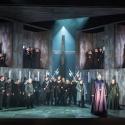
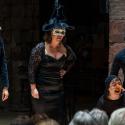
 Nor are they in the dying Tristan's string of insanely taxing monologues, where the wood of Act II becomes a fibrous thicket mirroring the tangle of infinite desolation and Forbis has his finest moments in going further than any Tristan I've witnessed other than the incomparable Jon Vickers in expressing fathomless despair. Wagner's finest poetry of nullity is vividly expressed here. The feverish obverse of hope realised only at the point of death isn't quite as vivid from either tenor or orchestra, and the lighting of Isolde's transfiguration-through-love (pictured right) proves a bit of an interpretative puzzle to this audience member.
Vocally, though, Petersen does her stalwart lover proud with more intense cascades of meaning. This is the first time, too, I've sat through a Tristan in which the servant friends so vividly implicated by Ollé in the lovers' concerns - a lustrous, sometimes playful Brangäne from Georgian mezzo Stella Grigorian and Jochen Schmeckenbecher's diction-perfect Kurwenal - go to make a uniformly strong line-up. That the evening never witnesses the overwhelming triumph of any one component, not even that of La Fura dels Baus, brings it closer to the total work of art than any other Tristan I've seen.
- Tristan und Isolde at Opéra de Lyon until 22 June
- See ENO 2010-11 Season on theartsdesk
Watch La Fura dels Baus's superb precis of its Le grand macabre