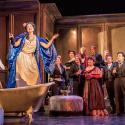
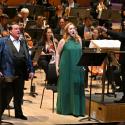
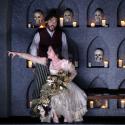
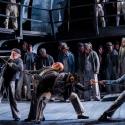
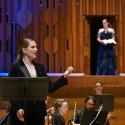
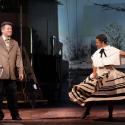
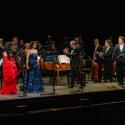
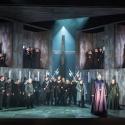
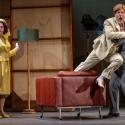
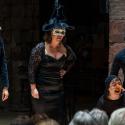
No point in going to WNO’s Turandot expecting to see images of old Beijing, for all the charming lady in a Chinese floral hat on the programme cover. The curtain goes up on the inside of an enormous galvanised dustbin festooned with photos of what might be lads from the football team but are actually Turandot’s victims to date. Calaf is a vagrant, Turandot a blue-suited Rosa Klebb, Ping, Pang and Pong fascisti bureaucrats in coloured suits, the “Popolo di Pekino” (both sexes) shirted and tied office workers, and so forth. Perfumes of the East? Forget it. This is Beijing Mussolini-style.
Like it or not, it’s a powerful revival, restaged by Caroline Chaney with back-up from the original director, Christopher Alden, and capturing brilliantly – more so, in my memory, than when the production was new 17 years ago – the amazing emotional energy of Puccini’s score, an energy that unfortunately evaporates at the point in the final act where he died and his pupil, Franco Alfano, bravely but vainly stitched together a kind of ending.
How do they manage it? Well, for once one can say that everything hangs on the musical performance, but also that the production team have understood how to work with the company’s strengths in this department. Chief among them is the chorus, in majestic voice from curtain-up and constantly providing a spectacular sound correlative to the barbarities on the stage. A few ensemble problems on the first night in the great “Gira la cote” chorus, with its curious echoes of the Volga boatmen. But mostly this was highly integrated ensemble work, perfectly matched to the stylised eurythmics of the opening scene, the ebbing and flowing spectator sport of the riddles, and the pyjama-ed menace of the final act, where the people, sleepless and desperate, turn on Liù to extract from her the name of the unknown prince.
Alden’s political point here, that Puccini’s last opera is a coded attack on the fascist regime, is perverse and unhistorical. But it works dramaturgically up to a point, and it often works with the music. The three masks, neatly played by David Stout, Philip Lloyd Holtam and Huw Llywelyn, are at once sinister and funny, and their sentimental attachment to their long-lost country homes as they pile up the death warrants is something very Eurotalitarian, like Hitler’s love of dogs.
The image of a state where everyone, including the Emperor and his bloodthirsty daughter, is inescapably locked into a rigid structure dominated by fear also helps the music at moments. Rebecca Evans’s wonderfully statuesque Liù, deeply touching in the stillness of “Signore, ascolta”, dignified without being mawkish in “Tu che di gel sei cinta”, carries with her a moral purity one doesn’t necessarily associate with Puccini. No less convincing in this context is the riddle scene itself, arranged like a courtroom with its public gallery, its bench of scribes, its clear spatial demarcations within which Turandot’s movements towards Calaf, so seemingly out of character, make a strong impact. From the start it’s a relationship touched by ambiguity, at least on her side. Half-loving him on sight, she practically gives away the third riddle by staring him in the face as she repeats the question to which her name is the answer.
Is it fair to expect even a top fascist to sing “In questa reggia” without at least some kind of fancy-dress cover?
Whether Anna Shafajinskaia’s singing is helped by this soft apparatchik image of Turandot is a moot point. One might doubt that such an office tyrant would turn (not to say detach) so many princely heads. But a more serious question is whether it’s fair to expect even a top fascist to sing “In questa reggia” without at least some kind of fancy-dress cover. Somehow the exposure of those initial high D’s, sung cold, seemed to be aggravated by the severity of the costume, and Shafajinskaia took a while to get into her stride, only opening out in the more richly orchestrated G-flat section.
The Calaf, Gwyn Hughes Jones, also has his quarrels with the production, which unkindly places him upstage for several of his big vocal moments. He’s a stylish and fearless singer of this music, though the tone can thin under pressure. And in the end the character is nearly as impossible as Turandot’s, however stunning the music. As they step over the corpses of Liù and Timur (Carlo Malinverno, suitably quavery) into each other’s arms, one can only feel that they deserve each other, and it simply remains to decide who’ll do the washing up.
It won’t be Lothar Koenigs if I allocate the tasks. His place, after getting such splendiferous playing from the WNO orchestra and such a powerful performance all round, is decidedly with the angels. And they don’t do housework.
- Turandot at the Wales Millennium Centre until 5 June
- See our Regional Opera 2011 guide to Welsh National Opera, Scottish Opera and Opera North