Before the Plays That Went Wrong and the multi-role six-hander Operation Mincemeat, there was Patrick Barlow’s adaptation of The 39 Steps: four actors on a collision course with feasibility.
Barlow is a comedy hero for creating the National Theatre of Brent in 1980, where as preening thesp Desmond Olivier Dingle he performed two-handers with a rotating door of partners that included Jim Broadbent. They considered no topic too epic, from the Zulu Wars to the Greatest Story Ever Told. Barlow’s 2005 version of John Buchan’s 1915 spy thriller, filtered via Alfred Hitchcock’s 1935 film, similarly relies on the ability of a teeny cast to engage the audience in their ludicrous antics while representing what the publicity blurb claims is 139 characters (doubtful, but it’s a lot). This is genial slapstick that leaves a warm afterglow.
The play’s initial West End run garnered awards including an Olivier, graced with the suave charm of Charles Edwards as Richard Hannay. It feels less unique now, but is still a nicely silly treat, a sort of panto for grown-ups, but with sly parodies of Hitchcock’s oeuvre at every turn.
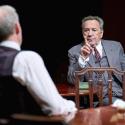
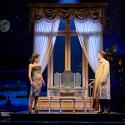
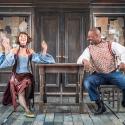
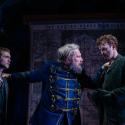
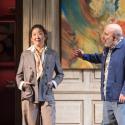
The new Hannay, Tom Byrne, is more ruffled than Edwards, but as impressive a pratfaller and a convincing Impossibly Posh Chap. He hails from a Britain where a man in an expensive three-piece tweed suit can complain about his dull little rental in Portland Place and seek solace at the variety show at the London Palladium, with “foreign agents” lurking in every shadow. The beautiful women who cross his path are slinkily played by Safeena Ladha (pictured below, left, with Eugene McCoy, Tom Byrne and Maddie Rice); all the other roles are juggled by two fine Clowns, Eugene McCoy and Maddie Rice.  The little boxes on either side of the Trafalgar’s proscenium arch work a treat in the recreation of the London Palladium, where Hannay first encounters Mr Memory, the unwitting spy-ring collaborator. For the main, multi-purpose playing area, the brick back walls of the Trafalgar have been left exposed, and items of old furniture are whisked on and off to create trains, cars and other notional scenery that the plot requires. As the action unfolds, the terrain gets trickier: the actors have to dangle from the Forth Bridge, cross misty Scottish moors and bogs, be perilously driven through the night by foreign agents and negotiate the sequence from the film where Hannay is handcuffed to a protesting Pamela, before the plot climaxes back at the Palladium.
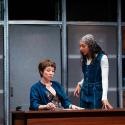
McCoy in particular is huge fun to watch, improbably bendy and prone to memorably weird hand and facial gestures – especially as Mr Memory, who with his MC (Rice) perform exaggerated mechanical deep bows until their bodies create right angles. He will reappear as sundry agents, policemen and hotel workers, even a cleft in a rock and a tree, with outlandish women a speciality and Rice as his often hen-pecked male partners. In one standout scene, the two play both the dastardly secret agents on one side of a hotel reception desk (who are not so secret in their giveaway uniform of trench coats and trilbies) and the ancient husband and wife hoteliers on the other – a feat not seen since Michael Palin held himself up in a DIY shop in Do Not Adjust Your Set. Rice tops that in a later scene by playing two characters at the same time.
 As well as the verbal and physical dexterity of the performers, there is a vein of humour in the production’s deliberate malfunctions to enjoy. The cast are left staring crossly as clouds of dry ice and telephone rings arrive late, or a wrongly placed armchair has to be awkwardly shunted into position by its occupant. An endlessly unfoldable map becomes a fun sight gag; another has McCoy and Rice being miscued to bring on a portable lamppost for the spies to stand under. In fact, all is executed with pinsharp accuracy, down to the accompanying ping in the final scene as a Christmas tree’s lights are switched on. The tech crew rightly take a bow of their own at the curtain call.
Most of the incidental music is familiar but works as a mocking accompaniment to the faux histrionics here. As well as the jaunty theme from the film, it features dramatic extracts from Bernard Herrmann’s Hitchcock scores, soaring music that projects the misdirected passions and violence of its plots. The poignant theme from Vertigo, the story of a man who dresses up a woman as his lost love, accompanies Pamela in the more mundane context of getting undressed for bed; snatches of the Psycho shower scene music play over a shadow-puppet “stabbing`" behind a curtain McCoy is holding up. As is customary, Hitchcock himself turns up. He has a cameo in an elaborate silhouette show played out on a giant cloth, where his big-bellied figure watches as a stick-man Hannay is chased across Scotland: cue touches of North by Northwest and a guest appearance by Nessie.
Typically of Barlow’s work, there is a trace of genuine emotion in among all the daft capering (I confess to having been unexpectedly moved once while watching Broadbent as the National Theatre of Brent’s Virgin Mary). Here it emerges when Hannay finds himself addressing a political meeting (the audience) without knowing what it is about. After some time-wasting blether, he defaults to proclaiming his core beliefs, and in a rousing, misty-eyed speech calls for a world of freedom, peace and unity, while the music to “Jerusalem” solemnly plays in the background.
It’s a glimpse of Buchan’s world, newly launched into a global conflict, beneath all the parody. Then Hannay triumphantly mispronounces the name of the political candidate, Mr McCorquodale, he is supposed to be endorsing – “Mr Crocodile!” – and becomes a posh ass again.