The word “immersive” is overused. When an immersive experience can be anything from a foreign language course to a trip down the Amazon on a headset, what might immersive dance involve? Not watching from a plush-covered seat, probably, and the dance not happening on a stage.
The Canadian choreographer Robert Binet has thought hard about how to effect greater proximity of dancer and spectator, short of the performers sitting in our laps. His project Dark With Excessive Bright, opening the Royal Ballet’s Festival of New Choreography, is a hugely imaginative, at times thrilling, attempt to bridge the gaps between watching, doing and feeling – an attempt also to open a window onto the spirit of collaboration that exists in the making of a piece. It even goes a step further in bringing on board something called Immersive Descriptive Audio, offering a parallel experience to the hearing- or sight-impaired. This isn’t the usual dry account via headphones of how the scene looks or sounds. To judge by the extract in the printed programme, it’s more a free-ranging, stand-alone poem. I regretted not having come equipped to plug in to this intriguing new dimension. The most obvious difficulty in bringing dance up close with its audience is practical. Where do you put people so they don’t get in the way? First off, the Linbury Theatre has been cleared of all its stalls seats. On the floor designer Shizuka Hariu has defined three circles, each fenced by slanting steel cords, in the manner of a suspension bridge. The cords are spaced widely enough for a ticket-holder, wandering about in semi-darkness, to slip through with ease, but it’s clear from the outset that the circles are for the dancers and the perimeter areas are for us groundlings. With dance happening in two or sometimes all three circles at once, we are encouraged to walk about and try different viewpoints. However, so startling is the arm’s-length proximity of the dancers that most people are rooted to the spot.
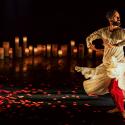
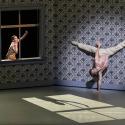
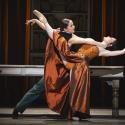
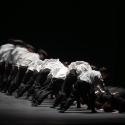
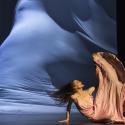
The sheer physicality of ballet dancers is always striking – the elongated spine, the exquisite balance of head and neck, the sleek limbs – but skin-tone unitards exaggerate these superhuman qualities. And while you know that these dancers – six women, five men – are not actually naked, as a streak of flesh-colour flashes by, some primal flagging system in your brain tells you otherwise. The single piece of fantasy in the design is a swathe of translucent jungle-print silk pinned to each dancer that ruffles and floats as they move (pictured above, Taisuke Nakao and Nicol Edmonds). Lighting by Simisola Majekodunmi precision-sculpts their bodies. In such an alien setting, and with no narrative, you reach for anything familiar. The opening minutes, as the audience shuffles into position around the main circle (how lumpen we seemed!), peering up as a circular lighting rig makes a slow descent, are straight from the film Close Encounters – the scene where the spaceship lands. Later, in a solo from Martin Diaz, I thought I detected the poses of the faun in Nijinsky’s l’Après-midi … Soon enough, though, you stop clutching at straws and surrender to the moment: a dancer embodying water – showering under it, running his fingers through it, submerging in it, being it – and another dancer clearly the sun. An outburst of explosive technical steps from Joseph Sissens (top image) may have been hinting at fire, but it hardly matters. The fascination of seeing the detail of dance so close mutes the whys and wherefores.
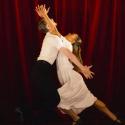
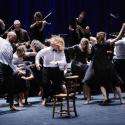
Music by Missy Mazzoli supports rather than drives the choreography, its dogged block chords, from a small string band installed in the shadows, occasionally breaking free into improvisatory solos for fiddle, cello or piano. And as the dancers swap about, exiting their circle to form a new duet or trio in another (Reece Clarke and Melissa Hamilton, pictured above) they step through the audience like ghosts passing through walls, leaving a trail of awe. There is a strong sense of continuum, and no time to complain of aching legs. A digital stopwatch on the wall ticks away the seconds and stops at 45 minutes precisely, at which point one is swiftly ushered out and up the stairs, just as a new audience cohort is being ushered in. A glance into the lighted circle below showed two dancers, dancing on.
- Dark With Excessive Bright at the Linbury Theatre to 20 February. The Festival of New Choreography continues to 25 February
- More dance reviews on theartsdesk