Greek myths are all over theatre stages at the moment, their fierce, vengeful stories offering unnerving parallels with events in our modern world. The latest such project is a pithy double bill of opera and dance, both halves (though the first lasts only 20 minutes) featuring the half-man, half-bull Minotaur, and the havoc he wreaks, even in death.
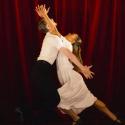
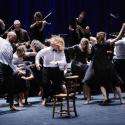
Benjamin Britten’s Phaedra – a work he called a cantata but which is more like sung psychodrama – uses the poet Robert Lowell’s translation of Racine’s Phèdre to explore the fallout from the character’s disastrous sexual journey. Marrying the man who deserted her sister then, on her own wedding day, conceiving a desperate passion for his son was never going to end well. Including the grand piano as part of the set, Deborah Warner directs Phaedra’s stream of confession and regret as if she is already in the Underworld. We first meet mezzo Christine Rice (pictured above), barefoot in jeans and a scruffy shirt, groping her way across a blindingly white stage containing three objects hidden under dust sheets. Each mound in turn triggers a memory – the dead Minotaur (slaughtered by her husband Theseus), her wedding shoes, and a dead youth, her stepson Hippolytus, slain to save her reputation as Theseus’ bride.
Britten’s score is even starker in piano reduction than in its original orchestral form, stretches of low, tolling octaves alternating with wild flurries of clashing notes. Pianist Richard Hetherington does well in keeping a cool head while Rice sings and acts with fearsome force and focus. Britten’s vocal writing makes extravagant demands, such as singing the word “purity” at top volume on a note well above a mezzo’s usual range, at other times asking the singer to whiten her tone to a ghost of itself. It could be argued that the drama is already all in the music and anything else superfluous, but some form of staging is clearly necessary here to balance the double bill. The director’s best visual idea, which for me is justification enough, comes in the final three minutes, as Phaedra creates her own shroud from one of the sheets. It’s this that haunts you after the final three, surprisingly wistful piano chords have died away.
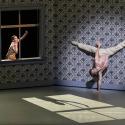
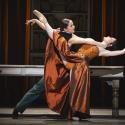
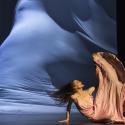
What follows after the interval was created by the choreographer Kim Brandstrup two years ago as a companion piece, with Antony McDonald as designer for both. In Minotaur, a black backcloth bears a slash of red paint, the paint pots and brushes still on the floor. The allusion to blood, violently shed, is obvious enough. But the canvas and brushes are a reminder of all the great artists, from Titian to the late Frank Auerbach, who have been drawn to this story. Somewhat confusingly, for those of us who have trouble enough getting our Greek myths in order, this bit of the Minotaur story precedes the events in Britten’s Phaedra. Ariadne, Phaedra’s sister, guards the maze where the Minotaur is kept, and it is she who helps her lover Theseus to slay the beast and exit the maze. Kirsten McNally (pictured above and top, with Tommy Franzen) watches from a high window as Jonathan Goddard, as Theseus, wrestles Franzen’s man-bull. It looks like a proper fight until you realise that only dancers could land so silently. Theseus and Ariadne’s celebratory dance is full of lusty rustic vigour, sound designer Eilon Morris supplying Cretan folk-fiddle numbers that defy you not to tap your foot.
Brandstrup has always been a choreographer unafraid of beauty, and there are long lovely minutes in a nod to Romeo’s leave-taking of Juliet, and then in Ariadne’s lament when Theseus has abandoned her. But the most memorable choreography comes in the final section as the god Dionysus (Tommy Franzen again), takes pity on Ariadne and descends to earth to partner her, using handholds in the back wall to give an impression of slo-mo free-fall, insouciant, floating, like a buzzard riding thermal currents. It makes for a breath-holding several minutes, immeasurably enhanced by being accompanied by the slow movement of Schubert’s late D major piano sonata, itself a miracle of withheld tenderness for the world and its folly.
It’s an inspired choice, the movement allowed to run its length, bringing the story to a perfect close. Unaccountable then, that neither the sonata, nor its composer, nor its (very fine) recording artist, are credited in the printed programme. Quite apart from being careless this is deeply unhelpful to the audience, who will have gone home with that music resounding in their heads and want to look it up. In an age when, in the cinema, every last sandwich-maker is name checked, this has to change. That said, further novel presentations of this kind, shared between opera and ballet companies, are surely worth pursuing.