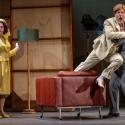
Flesh-tearing, woman-raping, body-goring brute he may be, but he's misunderstood, that Minotaur. It's a bold argument to make, but this is the contention of Harrison Birtwistle and David Harsent's 2008 opera. They are aided by a surprisingly cuddly performance from John Tomlinson. Head trapped in a prosthetic bull's cranium, hairy belly flopping out, a small stick-on penis standing to attention, Tomlinson is a reluctant and eloquent (if still pretty hideous) half-man, half-beast, soliloquising soulfully on his existential crisis (that of being treated as all-beast when he sees himself as mostly man).
Less sympathy is extended to Ariadne, the Minotaur's bored gate-keeper. Her efforts to secure herself a one-way ticket off Crete by eloping with Theseus - who appears on the island with several fellow Athenians who Ariadne is quite willing to send to their deaths - is unflattering behaviour in the extreme, especially as it's born of ennui and lust. In this way she is the second half-man, half-beast we encounter and is perhaps more beastly than the beast in this rendering.
Tomlinson's unwilling Minotaur, his feet almost dragging in the bull ring, was poignantly done
No relativistic moral helping hand is offered at all to the Keres, the third half-man, half-beasts, an all-female band of vulture-like body-devourers and yelpers (immoral Valkyries essentially). But then theirs is not a substantive role but a Grand Guignol one, offering us a nicely entertaining, solidly camp close to the first act after the thoughtful to-ing and fro-ing. Theseus is as all-good as the Keres are all-bad and the worse for it. Next to the many moments of introspective downtime with Ariadne and the Minotaur, the blustery episodes with superhero Theseus (not helped by a slightly unconvincing portrayal from Johan Reuter) were tedious.
But whenever the drama flagged - and there are moments of repetition or obviousness in the first half and second - one could simply sit back, watch and listen. The music didn't quite hit me between the eyes like it did when I first encountered it in 2008. I think Tony Pappano (the opera's first conductor) probably drove things harder and more dramatically than Ryan Wigglesworth. But Wigglesworth's less tempestuous approach allowed one to savour the detail. This time one could glory fully in the rich washes of orchestral colour spattered with, and shaped by, percussion. Ariadne's two or three jittery arias were particularly memorable, as the chaos that is so often confined to the percussive subconscious (occupying two boxes on the sides) leapt into the main orchestra.
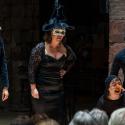
The singing was very fine. Christine Rice navigated her discursive part with bel canto-like continuity and beauty, while retaining vocal muscularity and drama. She also balanced the demands of her Janus-faced character extremely well, maintaining plausibility and a sliver of sympathy even in the villainy. Tomlinson's unwilling Minotaur, his feet almost dragging in the bull ring where he is egged on by a mysterious, masked chorus (who sang with great ritualistic power) to slay his victims, was poignantly done. There was a terrific cameo from Andrew Watts as a Tourette's suffering twitcher of an androgynous oracle. Elisabeth Meister had an impressively Valkyrie-like voice, very befitting the leader of the Keres.
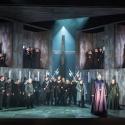
What made the evening, however, was designer Alison Chitty and director Stephen Langridge's staging. Quiet, economical, rite-like, the activities of the characters take place under collapsable heavens that open and shut like a puppet's mouth. One sky offers the hazy dawn of the Greek islands, sun and moon slowly jockeying for position. The other is the striated cave of the labyrinth. These Cy Twombly scratches are repeated - in blood - on the walls of the Minotaur's bullring. It was everything a set should be: a perfect blend of intelligence - of subtle engagement with and echoing of the ideas in the text - and aesthetics.
Greek drama and its intense gaze on life's essentials has often come to the rescue of opera at times of excess. It has so again. The Minotaur is undoubtably a keeper.