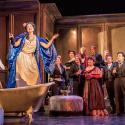
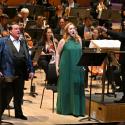
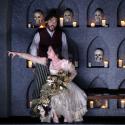
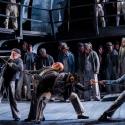
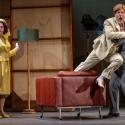
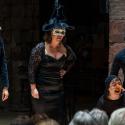
When first seen at Serge Dorny’s Opéra de Lyon in March-April this year, American Gary Hill’s unusual vision of Beethoven’s Fidelio could be recognised immediately as concept opera: drama where a director’s “idea” largely takes over the story. Hill directs (up to a point), and conceived the mesmerising projections that dominated the stage (realised, with jaw-dropping skill, by his technical assistant).
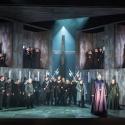
Two ideas, culled from fragments of Beethoven’s ponderously-evolved libretto, dominate this production, revived at Edinburgh’s Festival Theatre. First, that events take place on a futuristic spaceship – hence the ridiculous, inconsistent costumes that risk turning Leonora and Pizarro into ludicrous ciphers, and with it the myriad, semi-relevant circling star signs. Secondly, that the idea of “liberty”, so perfectly expressed even in this variable original libretto, has to be hammered home ad nauseam. This is handled both aptly (by some pontificating use of Beethoven’s own diaries), and less so by numerous concocted references to starry hocus-pocus, inserted in the spoken and sometimes sung passages by Hill.
 The truth is, we need Beethoven and we arguably don’t need Gary Hill. There were pluses. I too was mesmerised by the front curtain projections (white on black apart from a wonderful floral outburst which greets the very good Prisoners’ Chorus – nominally evacuated, but now repressed by this director). One was in awe of the technology: tear-jerking stick-man prisoners in hunched postures above the recumbent Florestan (a vocally satisfying Nikolai Schukoff, awakening in a time and space tunnel, above), and felt wonderment at the ultimately benevolent universe that Hill insistently evoked. The idea was not duff, or even overdone. It was consistent; one was beguiled like a small child playing with a kaleidoscope.
But most of this was at the expense of the characters. They were curtain-bound, and you couldn’t always hear them perfectly. Christoph Baumgärtel’s businesslike Jaquino, the fabulous Moldovan soprano and 2011 Cardiff Singer of the World competition winner Valentina Naforniţă, and superb bass-baritone Pavlo Hunka, an acclaimed Falstaff and Wozzeck and an ENO regular: all were unduly muted and looked frankly ridiculous. Leonora’s outfit made Swedish-born Erika Sunnegårdh look silly and fat, while her shivering late intervention was fluffed not by her, but by the direction.
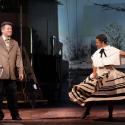
 Riding around the stage on naff wheels didn’t help, but the glorious Viennese Michael Eder as Rocco rode above all to give the best performance – lucid, commanding, sympathetic, rich right across the range. Eder (pictured centre above, with Erika Sunnegårdh) recently starred in concert as an oppressor in Karl Amadeus Hartmann’s Simplicius Simplicissimus, an opera on tyranny akin to Fidelio and as good, yet ludicrously neglected by major houses.
Shenanigans apart, the one person who did guarantee a superb Fidelio was Opéra de Lyon’s music director, conductor Kazushi Ono, who brought such intelligence, precision and empathy with text and music that his integrity nearly blew all Hill’s fripperies away. You felt Ono’s strength in Florestan’s revival, the impact of Leonora’s big aria, and the redeeming arrival of Don Fernando (Andrew Schroeder, who eclipsed Hunka’s diminished Pizarro even more than the pathetic, billowing quasi-Japanese costume did).
Hill’s wheeze was to run two ideas together in counterpoint, a meeting of Napoleonic 1814 and future constellations. Happily we still got the 1814 bit. Quite what the rest of it was about, heaven knows.