

From a distance, the pianist Christian Blackshaw bears an uncanny resemblance to Franz Liszt, silver hair swept back à la 19th century. At the piano, though, you could scarcely find two more different musicians. There seems not to be a flamboyant bone in Blackshaw’s body.
Blackshaw’s choice of three Mozart stand-alone pieces to form a type of sonata might not be entirely convincing, but each is a sliver of perfection in its own right: the dark billowing of the D minor Fantasia K387, the insouciant charm of the D major Rondo K485, and the mysterious Adagio K540 in B minor, an unusual and implicitly very personal choice of key for Mozart, seem to show us the composer’s most intimate moments confiding in the piano keyboard. Blackshaw’s rounded, luminous tone suits the songfulness of Mozart’s phrasing, but he never turned the pieces into miniature operas, taking them on their own terms and with nothing more or less than their own intent. 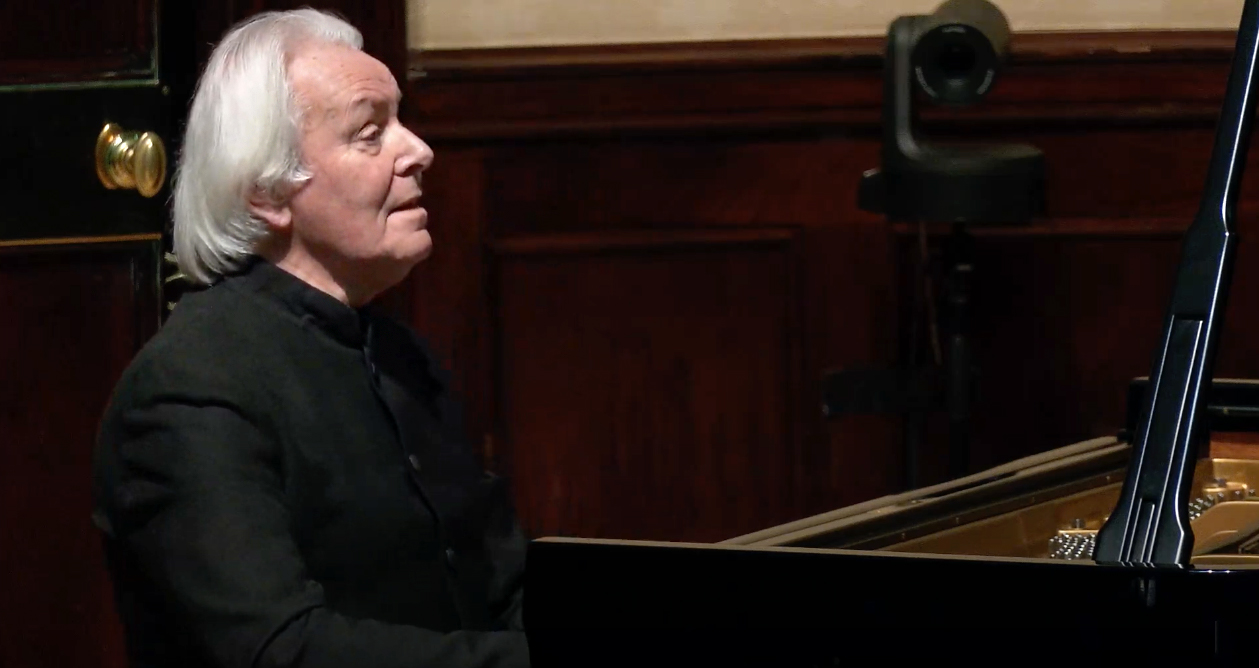 Mozart is a composer for all seasons, yet somehow Schubert best suits winter, with shadowy, hushed evenings sheltering from the snow. The instrument could be the repository for some of his darkest thoughts, but not in the D major Sonata D850, where he sometimes seems to plaster on the Austrian-mountain charm with a bit of a fixed grin. It’s a strange bird in its composer’s sonata nest, its feathers brighter and its call louder than many of its siblings. Schubert is an ideal composer for Blackshaw’s type of pianism, with that pure tone, subtle emotionality and beautiful legato, and if his playing here occasionally verged, in the first and third movements, on the slightly over-determined, that’s partly the composer’s doing. For instance, the scherzo is built on an awkward yet obsessive rhythm that scarcely lets up but for a breath of fresh air in the trio, and it’s rare that it flies easily.
It’s a sonata that – unlike some of Schubert’s others – seems designed for a public, or at least a small Schubertiade gathering of close friends. At the moment no concert hall can hold so much as that, and the loneliness of the long-distance communication sometimes seemed palpable. The second movement, though, was magical, with a hushed, breath-holding beauty that perfectly captured Schubert’s knife-edge between smiles and tears. And that is pretty much where we remain.











