A blink-and-you’ll-miss-it domestic farce and a fever-dream fantasy of a song-cycle: Stravinsky’s Mavra (1922) and Schoenberg’s Pierrot Lunaire (1912) make for an unexpected double-bill. But, if the two stand slightly awkwardly next to one another, they are both facing in the same direction – each looking back into the musical past.
Passacaglias and fugues, love-duets and ensembles, waltzes and folksongs: these are the fragments gathered up by two composers less interested in tearing down the musical establishment at the start of the 20th century than re-purposing it, twisting and skewing the pieces to fit the anxieties of a new age.
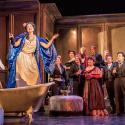
Anxiety, tipping into confusion, paranoia and outright madness, is the defining mood of Anthony Almeida’s new staging, devised as part of the Royal Opera’s 20th anniversary celebrations for the company’s Jette Parker Young Artist programme. Designer Rosanna Vize takes the “miraculous white roses” of Pierrot’s vision and blows them up into a giant floral pattern: an oversized chintz that sets the tone for the surreal, circus-domesticity of Mavra in which tea-tables come laden with jelly (and nothing else), pastels and prim silhouettes explode into outrageous wigs and purple eyebrows, and crinolines conceal holsters of squirty cream.
 The story (based on Pushkin’s The Little House in Kolomna) is simple enough: Parasha misses her boyfriend Vasily, so when her mother laments the loss of the family’s faithful retainer Fyokla, she conspires to bring her lover into the household in the guise of “Mavra” a new maid. Cue all the classic comic-opera shenanigans.
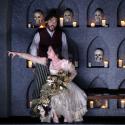
The slightness of Mavra (which lasts scarcely half an hour) gives a director little elbow-room, and Almeida makes the interesting call to bleed one drama into another, uniting the two disparate halves in a shared world in which an oversized hanging lamp becomes the moon that guides Pierrot’s madness. Pierrot himself strays into Parasha’s tea-party, and later Parasha and her friends reappear in Pierrot’s own fantasies.
Meaning remains oblique, but tethering Mavra to something bigger lends welcome heft to its arch satire. Something primal is stirring in Almeida’s dolls house, felt not just in the slithering clarinets and off-kilter dances of Stravinsky’s score (crisply delivered by the Britten Sinfonia under Michael Papadopoulos) but in characters who plunge their fingers American Pie-style into bowls of jelly, smear themselves in cream and strip down to their underwear.
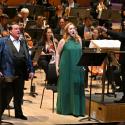
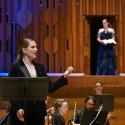
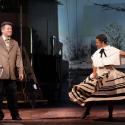
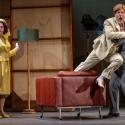
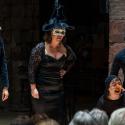
Jette Parker artist April Koyejo-Audiger brings plenty of bright-eyed naughtiness to Parasha, her soprano swelling generously through Stravinsky’s ensembles, but sometimes spilling outside the tightly geometric lines established by Papadopoulos, smudging pitch. She seems to belong to a different opera to Egor Zhuravskii’s tidy Vasily (pictured right) – darkly Russian tone meeting bel canto control and sweetness. Sarah Pring shines as Parasha’s put-upon mother (barely clinging to sanity here) with Idunnu Munch adding some zesty confusion as the Neighbour.  It's all good fun and doesn’t overstay its welcome. But it’s the second half where this show really comes into its own. Soprano Alexandra Lowe (pictured above) is Schoenberg’s moon-struck Pierrot – holding her audience through every shift of mood and character: now a Madonna mourning in a twisted Pieta, now a murderous revenger drilling through his rival’s skull to smoke it like a pipe.
Stilling the visuals after the clutter and chaos of Mavra, Almeida lets the action move to Lowe’s face and body, tellingly lit by Lucy Carter. Committing absolutely to each reinvention, from cabaret-performer to crawling animal, ballroom dancer and androgynous lover, Lowe gives us madness that’s never less that precise, underpinned less by the whimsy we often see than a slow-bubbling rage and bitterness.  The control of Lowe’s sprechstimme, plucking pitches from the air, morphing her tone to mirror or battle the orchestra’s flute or clarinet, is absolute: a carefully calibrated negotiation between speech and song. Madness can be anarchic, but it’s far more compelling when we feel the underlying order and logic as we do here.