Thresholds are breached and barred, penetrated and sealed up in Harrison Birtwistle’s beguiling pair of mythological scenas The Corridor and The Cure. Originally commissioned by the Aldeburgh Festival in 2009, The Corridor is paired here for the first time with Birtwistle’s new companion piece, in a production first seen this month at Aldeburgh and now at the Royal Opera House. Sharing the same instrumental and vocal forces, The Cure serves both as commentary and response to the earlier work, a musical mirror that distorts even as it reflects.
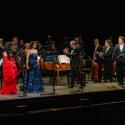
The Corridor remains an extraordinary piece of music-theatre. Birtwistle demands that its six instrumentalists (flute, clarinet, string trio and harp, played here by members of the London Sinfonietta) are integrated physically into the action, both agents and spectators in the terrible intimacy of Orpheus and Eurydice’s final encounter, “dancing” her back down into the darkness. Directing our ears with movement and clever spatial staging, director Martin Duncan here encourages his audience to hear Birtwistle's vocal and instrumental textures as the continuum they are, each enacting as well as narrating.
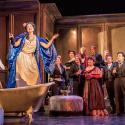
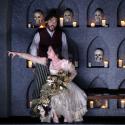
 The corridor of the title is not only the pathway from the Underworld but also the dramatic structure of this miniature. A familiar tale is focused and narrowed, restricted to a slim passageway of musical narrative that starts and ends right at the heart of the myth – the moment of Orpheus’s disobedience. Alison Chitty’s designs reflect this narrow intensity, saturating the small stage space with deep colours and angular shapes.
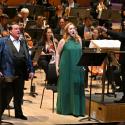
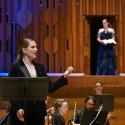
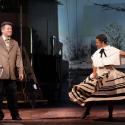
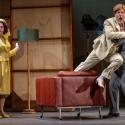
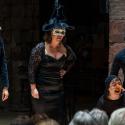
The effect is striking, a charged frame for two outstanding central performances. Mark Padmore (Orpheus, pictured above right with Atherton) finds and risks all vocal colours in inhabiting Birtwistle’s lines, mining David Harsent’s quietly lovely libretto for emotion. But it is Elizabeth Atherton (pictured below), here as Eurydice and later as Medea, who dominates. Urgent and absolute, where Orpheus is all song, she is rational spoken thought, interrogating rather than affirming: “This perfect love, this perfect match – do you believe in it?”
 Atherton’s intelligent musicianship is the pathway through Birtwistle’s drama, dense with textural interest. But where The Corridor offers the soprano a weighty partner and counterbalance in Orpheus, The Cure dilutes its impact, splitting Padmore between the twin roles of Jason and his father Aeson. The symbolism is neat in this twisted love-triangle, but dramatically it feels fractured, forced, at times. The Cure seems like an operatic monologue with interpolations rather than the two-hander that it needs and wants to be.
Conductor Geoffrey Paterson balances his forces beautifully, transforming the Sinfonietta’s solo voices in The Corridor into the meshed orchestral sound of The Cure, stressing both the similarities and the contrasts of two scores luminous with harmonic interest and shy gestures of melody.
If The Corridor is unquestionably the stronger, the more distilled, of the two pieces, this new pairing opens a satisfying musical conversation. The Corridor and The Cure are variations on a mythological theme, revealing human truths with as much delicacy and poignancy as any stage work Birtwistle has yet produced.