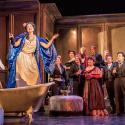
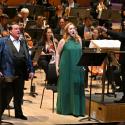
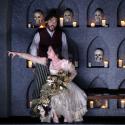
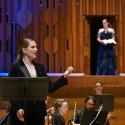
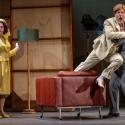
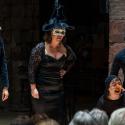
All those pranks, set-ups, fake letters and disguises, they just keep coming thick and fast in Verdi’s Falstaff. The score has irresistible energy and momentum. The composer made sure in his last opera that when the fantasies, schemes and hopes of Shakespeare's Sir John Falstaff are given apparent encouragement, only to be systematically unpicked and nixed, it all happens with allegro markings like vivace, brioso and brillante. And this was a musical performance led by Richard Farnes with exactly the right kind of verve about it.
And yet the dreamy setting, the Wormsley estate where Garsington Opera has made its summer home for the past eight years, with its astonishing grounds and gardens, seems to impart an air of unreality, detachment, immateriality. It almost has its way of intruding on the unfolding story. I found my attention drawn by a vast elder bush to the left of the stage outside the opera pavilion, which just stands there and quivers in the summer wind, insouciant to the passions, machinations and frenetic action onstage.
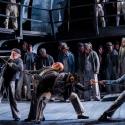
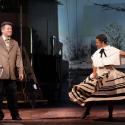
And talking of trees, where were they? It is probably pedantic and over-literal to mention it, but there is a scene where Verdi and librettist Boito specifically ask for them. They even say where on the stage they want them: “in the middle of the stage with Ford’s house to the left”. Garsington’s production directed by Bruno Ravella has not just teleported the action of Falstaff from the reign of (the English) Henry IV into the early 20th century, and the period of the suffragettes. It has transplanted that particular domestic scene (Act 1 Scene 2), and jollied it up by setting it on the concourse of a station, complete with a puffing steam locomotive, which duly received its own round of applause (pictured below, Hollie-Anne Bangham (chorus) Victoria Simmonds, Yvonne Howard, Soraya Mafi, Mary Dunleavy).  What does the updating achieve? The main answer is to reinforce and semaphore the implicit message that it is the women in the story whose will is going to prevail. That’s no bad thing, but Falstaff risks not being just a figure of fun; both the updating and the stage business point a more constant wagging and accusing finger at him. This Falstaff is not just a fantasist, but an abuser of women.
Bass-baritone Henry Waddington (pictured below) was making his debut in the role. Surrounded by stalwarts of the UK opera scene, formidable character actors such as Yvonne Howard in the role of Mistress Quickly or Adrian Thompson as Bardolfo, I thought he was simply outgunned on this opening night. As Geraint Evans once told a young Bryn Terfel, “presence on the stage has to be something that holds the eye of whoever is spending their hard-earned cash to see you.” For presence also read swagger. Is Henry Waddington capable of that? Yes, and as the run progresses he is bound to put his own stamp on this role more than he did on Saturday. 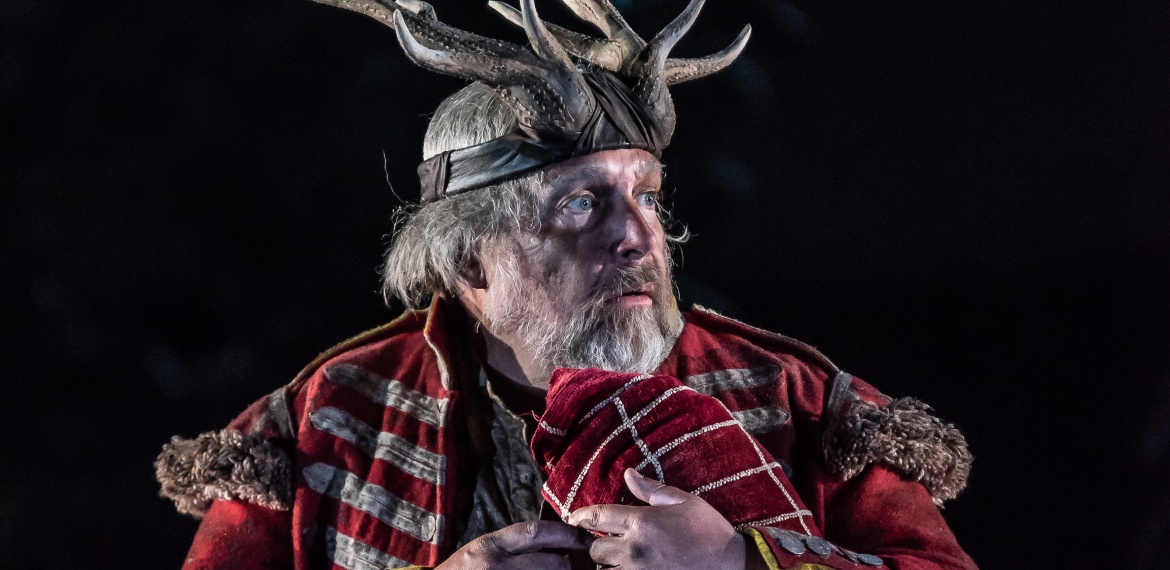 The other principals were excellent. The crispest enunciation, the best Italian and huge rhythmic positivity was coming from Richard Burkhard in the role of Ford. Mary Dunleavy as Alice and Victoria Simmons as Meg were both well-drawn characters. The young lovers Nanetta and Fenton both shone as performed by Soraya Mafi and Oliver Johnston, and Colin Judson was a highly memorable Dr Caius.
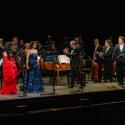
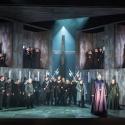
Richard Farnes conducted the Philharmonia Orchestra with real clarity and purpose. To my ears there was complete unanimity between stage and pit until one swiftly righted section in Act 3. Given the pace of the piece, that is no mean achievement for an opening night. And the wind principals of the Philharmonia really are a top-flight crew, notably Jill Crowther on cor anglais and, when the horn comes into its own in the final act, Nigel Black. The chorus directed by Susanna Stranders proved what a force for good they are in the final scene. The designs by Giles Cadle and the lighting by Malcolm Rippeth, particularly for the final scene in Windsor Forest, were delightful.
This is a thoroughly professional and well-executed Falstaff. And it has been a fascinating idea to juxtapose it for this thirtieth season at Garsington Opera with two other composers’ last works for the opera stage, Mozart's Die Zauberflöte and Strauss's Capriccio.