Valiant Opera Holland Park, always taking up the gauntlet for Italian operas which should mostly never be staged again. Worst was Zandonai's Francesca da Rimini, where musical ambition vastly outruns technique and inspiration. Mascagni's Iris with its hideous misogyny has now been followed by the same composer's Isabeau of 1911, turgid of libretto and dramaturgy. Leoncavallo's Zazà and Puccini's La rondine are in a different league, but both had already impressed London audiences in concert and at the Royal Opera respectively before travelling westwards. Here the heart sinks to see the same village-institute medievalism, with its creaking castle walls to match cardboard cut-out characters, that plagued director Martin Lloyd-Evans's almost unendurable Zandonai.
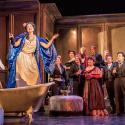
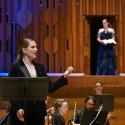
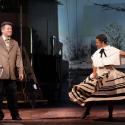
This starts more promisingly, with six onstage trumpeters in livery – albeit two in specs - backing up the announcement of a joust for the hand of fair Isabeau, King Raimondo’s daughter, newly emerged from chaste retreat. Her entry, albeit not on the required white horse, and later her ride through the streets on a puppet-y one, naked in Godiva fashion at the behest of her angry father, both have radiant and interestingly scored music, even if the latter is very sub-Strauss (Mascagni must have been aware of Der Rosenkavalier, another, earlier premiere of 1911). Young Italian conductor Francesco Cilluffo gets especially lovely phrasing from lower strings, but has some trouble co-ordinating a wide spread of players (the percussionists, way to his right, aren’t always in synch). The results are good enough to suggest that a worthwhile orchestral suite could be made from some of the opera’s music.
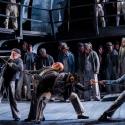
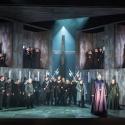
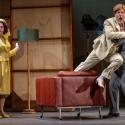
Yet oh, how it begins to drag when we switch to rural falconer Folco and his granny, come to court to beg a position for the young man; not even the ringing tones of the UK’s most Italianate tenor hope, David Butt Philip, can shine out fully given the limping pace and turgid text (by Illica, astonishingly, librettist of so many great Puccini dramas – what a good influence his co-writer Giacosa must have been).  There’s a rather striking pre-tournament chorus, sounding oddly like something out of Tippett’s The Midsummer Marriage, premiered over 40 years later, and brilliantly sung (if over-acted in some cases - ditch the idiot) by OHP’s young and golden chorus. The shifting bits of scenery actually come together quite effectively for a pageant-tableau (pictured above). The outcome, you think, could be positive: Isabeau only accepts one of the five suitors, the (to us) hilariously-named Ethel, rival to "Odoardo di Edimborgo" and others, out of pity, not love. But then it all goes pear-shaped for the iconic virgin: this is when dad (stentorian Mikhail Svetlov) orders the Godiva ride.
It doesn’t make much sense for the choral men to be brutalising their women after the interval when they agree to shut their windows to the sight of their naked lady and to punish anyone who looks on her with death. The one who happens to see her is the unfortunate Folco. Cue an inept end of scene and a final love-too-late semi-duet where Anne Sophie Duprels, always a strong presence on stage, warms up from her initial under-the-note delivery to match Philip for Italianate singing of great lustre. That’s ruined by another silly conclusion, for which Lloyd-Evans must be blamed as much as Mascagni and Illica. Well, it’s not a bore, if you must tick off these obscurities, but it is the sort of thing that gives opera a bad name, and the big question, to both Mascagni and OHP, has to be – why?