Barrie Kosky’s production of Moses und Aron was staged at the Komische Oper Berlin in 2015 to mark the 70th anniversary of the liberation of Auschwitz. Schoenberg’s opera is philosophical and open to a variety of interpretations. Kosky emphasises the story’s Jewish heritage, and the production is all about Jews and Judaism. That might seem a natural choice, given the occasion, but Kosky’s message is subtle, fully acknowledging the Holocaust, but presenting the Jewish people as complex and contradictory, and not just as victims.
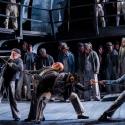
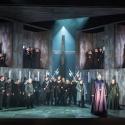
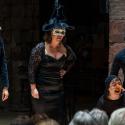
The production is dominated by the huge chorus, who are onstage almost throughout. The set is simple, a shallow ascending terrace, but it is also small and narrow, with a low ceiling. That gives a sense of claustrophobia, but even within these space limits, the singers move continuously, usually as a single unit—the “people” whom Moses must convince to leave Egypt. The chorus is the star of this production, their singing excellent, and their movements gracefully choreographed throughout.
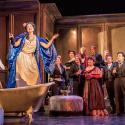
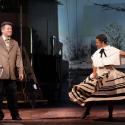
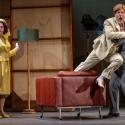
The two main characters, Moses and Aron, are presented in a variety of guises, and Kosky’s clear vision for the chorus is less in evidence here. The staging begins in silence, with lines from Waiting for Godot projected on the backdrop. And when Moses and Aron appear, they resemble Vladimir and Estragon. This is presumably intended to bring some dark comedy to the proceedings, and to highlight the Moses’ initial indecision about how he must act, but the comparison soon wears thin. Fortunately, Kosky has another entertaining idea to follow, turning Aron into a conjurer and Moses into his straight man accomplice. This is a better fit for the story, the magic tricks that Aron pulls a graphic parallel for his efforts to convince the people of Moses’ message. Tenor John Daszak is impressive as Aron. He was a late addition to an otherwise rigorously rehearsed production, but it doesn’t show. Vocally, he is on top of the demanding role. Some of the high notes are strained, but that tension fits the drama. He is also good at the magic tricks – the camera close-ups sometimes give away the sleight of hand, but no matter.  Where other productions focus equal attention on the two main roles, Moses is portrayed here as a more subsidiary character. That fits the musical portrayal, as the role is written in Sprechstimme – somewhere between singing and speech. Robert Hayward (delivers the part in a gruff, veiled tone, in stark but effective contrast to Daszak’s more lyrical Aron.
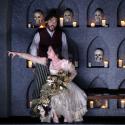
In the second act, the focus moves from Moses and Aron to the chorus, with the notorious Golden Calf scene. Kosky presents the scene as a complex allegory. Burlesque dancers, painted in gold, are filmed from stage right with an old-fashioned cinema camera, operated by dwarf actors dressed as Marx and Herzl. Meanwhile, the chorus hold up life-sized dummies, clearly identified as Jews. The scene culminates with the dummies thrown onto a pile, which then stands in for Mount Horeb, from which Moses descends. The opera is unfinished, and this production presents the score as Schoenberg left it, without a third act. But it feels complete for the sheer visual power of this second act conclusion, whatever message Kosky is trying to convey.
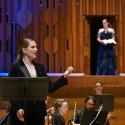
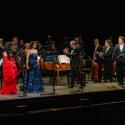
Moses und Aron was an unusual, and expensive, choice for a company more accustomed to operetta, and although it was well received, Kosky made clear at the time that there was no prospect of a revival. So this online video is especially valuable. The camerawork is often busy, with a lot of closeups, and occasional cutaways to details in the crowd, but that only emphasises the claustrophobia of the staging. Sound quality is excellent, with the orchestral lines immediate and clearly delineated. Credit for that should also go to conductor Vladimir Jurowski, sometime Music Director of the Komische Oper, returning here after a long absence. Jurowski brings his trademark clarity and focus, and the orchestra plays magnificently for him, the precision and detail of the music a fitting complement to studied abstraction of Kosky’s vision.
Watch the production on OperaVision's YouTube channel. English captioning available.