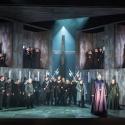
Schoenberg’s last, unfinished, opera, seldom staged, might almost have been written for the Welsh. At its heart is some of the most refined and intricate choral writing since Bach, but linked to stage directions so complicated that one wonders whether the composer had any idea of the technical difficulties he was putting in the way of a fully realized production. The fact that this new WNO production funks most of the stage business is not the fault of the company’s truly marvellous chorus, whose musical performance alone would be worth twice the ticket price.
As a conception, Moses und Aron is one of the most richly fascinating of “modern” operas (it was completed, so far as it ever got, 82 years ago). Its underlying subject, the chasm that separates spiritual ideas from their expression in terms that people can understand, is a direct allegory of the music in which Schoenberg cloaks it, composed according to a serial method as rigorous and abstract as the Mosaic law itself.
A strange idea for a stage drama, you might think. But you’d be wrong. On two distinct levels, Schoenberg makes excellent theatre out of his idea. By casting Moses as a profound but inarticulate thinker who can speak but not sing, while his brother Aron “explains” his thoughts in lyric song that everyone can appreciate, he sets up an intriguing series of dialogues that, on the second level, trigger the brilliant choral sequences – as vivid in their way as anything in Wagner or Musorgsky – which climax in the bloodcurdling violence and abandon of the dance round the Golden Calf.
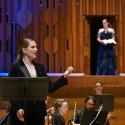
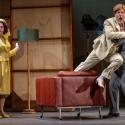
The music overrides the stage nonsenseThis is a fine, Verdian design: the public and the private feeding on, and eventually destroying, one another. But it needs space: an empty stage, perhaps, Aron emerging from the wilderness like an aerial spirit, the people as a mobile and eventually uncontrolled throng, Moses seen from a distance bearing the tablets. These are outdoor settings. Jossi Wieler and Sergio Morabito absurdly locate the entire action in what might be a modern debating chamber (Act 1) or – the same without the microphones – a cinema (Act 2). There are hints at a Middle Eastern politics; an Egyptian flag is set on fire. But the chorus, in day dress, is stuck in a huddle at the back of the chamber, or in the seats, being harangued by Moses or Aron; and when it comes to the Golden Calf and the eagerly awaited orgy, the directors throw in the towel completely and offer a mirror audience watching these events on a screen which, like Moses’s God, is invisible and inconceivable to the rest of us. A more abject failure of theatre would be hard to imagine; unless of course the metaphor, though wrong, is deliberate.
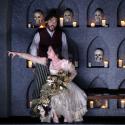
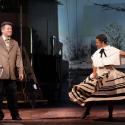
 The music, though, overrides the stage nonsense. As the increasingly helpless, bewildered Moses, John Tomlinson gives a performance that is as touching as it is masterful. Few singers make sense of Schoenberg’s speech-song notation; Tomlinson does so completely. Hardly less impressive is Mark Le Brocq’s smooth-talking, shallow-thinking Aron, taken over at the last minute from an indisposed Rainer Trost, but sung with an assurance that belies the extreme difficulty of music whose lyricism is constantly moulded to a fixed and somewhat angular sequencing of notes. Le Brocq (pictured right in Opera North's House of the Dead), though understudying the role, had I gather never sung it with the orchestra or on stage. You could hardly have known.
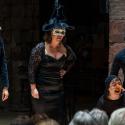
The rest of the cast are soloists who step out of the chorus. All are excellent, despite costumes and production that largely undermine their particular character. At one point in the score, Schoenberg nervously indicates that his Four Naked Virgins should be naked only “to the extent that the rules and necessities of the stage allow and require.” With Wieler and Morabito he needn’t have worried. The girls are never out of their jeans, even when being “violated” in the cinema seats, a spectacle about as sensual (or believable) as sex in Ambridge.
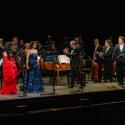
At the helm, Lothar Koenigs is in his element. This dark, intense, intricate score is very much his thing, and he pilots the chorus and orchestra through it with few tremors and much exquisite detailing. Whether its esoteric music will ever be whistled by taxi drivers, as Schoenberg optimistically hoped, it still makes its impact in such expert hands, even without the theatre it deserves.