Pierre Boulez simply crystallised the obvious when he described Debussy's unique masterpiece as "theatre of cruelty," despite its enigmatic beginnings. Richard Jones, when I asked him to talk about its plot, declared "it's about two men who love the same woman, with disastrous results". Productions by Jones, Peter Stein with Boulez conducting and Vick at Glyndebourne have all had us shaking with fear and weeping with pity. By going much further in symbolic abstraction than even the playwright of Pelléas et Mélisande, Maurice Maeterlinck, could have imagined, Stefan Herheim serves up a frigid mess. Robin Ticciati's hypersensitive conducting and a compelling new Mélisande can't save it.
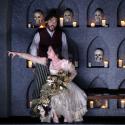
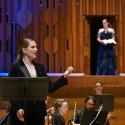
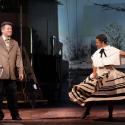
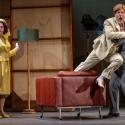
No doubt one could intellectualise the basic ideas in this nasty piece of metatheatre - seeing and blindness, light and dark, a rigid old society oppressing the young - all of which are there to be sought out in Debussy and Maeterlinck. But there's an immediate disjunction here between designer Philipp Fürhofer's recreation of the Organ Room at Glyndebourne, with the King of Instruments opening out to a forest of crown-topped pipes, and the extremely stylised action within it (pictured below, Karen Cargill as Geneviève, Christina Gansch as Mélisande and John Chest as Pelléas). We start at one possible end - the dead Pelléas on a sarcophagus which will serve as a well and, sinking down, a pool around which very constricted scenes are acted out. Then, on official curtain-rise, comes the discovery of Mélisande, recreating a symbolist painting, by the widowed and deeply unattractive Golaud (Christopher Purves) in plus-fours and straggly beard.  Herheim seems determined to have everything that happens in Debussy's fluid development of the drama take place too soon or at a different point to where the music says it should. So Golaud is physically violent with Mélisande long before his jealousy begins with the discovery that her wedding ring is missing. The young people whose love should develop so cautiously come too close too soon; Mélisande lets her hair down, but later than expected, and not from a high place (remember Vick's Christiane Oelze on the deco light-fitting? Here it's Golaud who's at the organ console, always watching). The regressive step of having a woman en travesti rather than a boy treble as Golaud's young son Yniold seems to be there so that "he" can transform into another long-haired Mélisande, but there is no terror or tension in the scene where the father tries to get the boy to spy on his wife and half-brother.
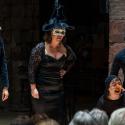
That makes it tough on Ticciati, who wins wonderful balances and clear lower lines from the London Philharmonic Orchestra, but can't generate the necessary heat when the singers are not engaged in the musical drama too. When the production is still, you register the extreme refinements of the score, as in the exquisitely nuanced scene within the sea-cave (feeble lighting effects on the organ are as near as we get to nature-evocation). Blame Herheim for Purves turning in the only unconvincing performance I've ever witnessed him give; one doesn't give a damn about this tormented and tormenting soul (and from the start the French isn't good). John Chest's Pélleas seems right until he comes to the crucial high-lying raptures of what should be an extended love scene, where the baritone cracks (this either needs to be the very specific high French type, or a tenor with a convincing lower register). Gansch's Mélisande, though, would be ideal in a more human production - strange but not fey, passionate when needed.  On the first night, deluded patriarch Arkel was sung with a little too much stentorian emphasis by Richard Wiegold from a box while Brindley Sherratt, suffering from a throat infection, acted out the role. Karen Cargill's lustrous mezzo-contralto is wasted on Geneviève, though she's always a presence, even when having to participate in the slightly risible communal dumb-shows that bedevil the later scenes. Chloé Briot (pictured above with Purves), the only French member of the cast, brings the scene where Yniold sees the symbolic sheep going off to the slaughter closest to real emotion. But as the action moves on, a slightly inebriated post-picnic audience is more liable to giggle at some of Herheim's more ineptly realised ideas, including Christ as good shepherd appearing in front of the organ console when Arkel sings of Mélisande as possible redeemer - the only second-half reference to the painting metaphor which adds an extra layer of confusion to the first with its empty easels. The final tableau, with Glyndebourne punters clutching programmes entering to look around the historic room, brought titters which shattered the hypnotic magic of Debussy's last bars.
The ultimate problem is not only that Herheim doesn't know when to let a clever idea go, having made its point, but that he only half-tells it. It's like seeing a play or opera in a foreign language without supertitles where you only get glimpses of what it's all about. And that's a level of mystery very different from Debussy's or Materlinck's. First-time viewers must have been even more baffled.
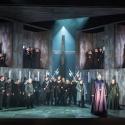
Add to that the fact that Vick's Glyndebourne Pelléas, perhaps the most hauntingly beautiful production ever seen there and designed by the late, lamented Paul Brown, also started out inside a claustrophobic mansion but suggested the scenes elsewhere far more effectively, and this has to be one of the biggest let-downs the country opera house has witnessed. The more so since European flavour-of-the-month Herheim flew into Glyndebourne on the wings of great expectations. Fortunately his Tchaikovsky Queen of Spades, seen in Amsterdam and heading to Covent Garden soon, is a much more convincingly worked-through concept. As for this one, perhaps wait until the Proms performance, where you may get some of the baffling physical gestures but not the distraction of the visual mésalliance.