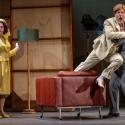
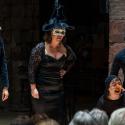
It's swings and roundabouts for Glyndebourne this season. After the worst of one director currently in fashion, Stefan Herheim, in the unhappy mésalliance of the house's Pelléas et Mélisande, only musically gripping, comes the already-known best of another, Barrie Kosky. His Royal Opera Carmen and The Nose were half brilliant, half misfire; Handel's cornucopia of invention, never richer, in the very operatic oratorio Saul brings out a hallucinatory vision from Kosky that works from start to finish.
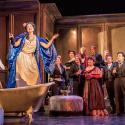
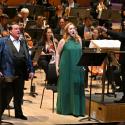
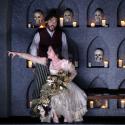
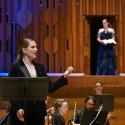
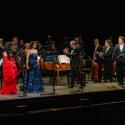
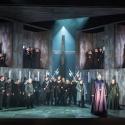
The one reservation this time round would have to rest with the characterisation of the eponymous Biblical king, stricken by an envy of the young Goliath-slayer David that Kosky enlarges as mental illness. Alexandra Coghlan described Christopher Purves's performance in 2015 as "an extraordinary piece of singing-acting that makes madness – unlovely, vulnerable, mercurial – poignantly human". I can well imagine it of a remarkable performer currently hampered by Herheim as a totally repulsive Golaud in the Glyndebourne Pelléas. Markus Brück is a powerful vocal presence, but "poignantly human" his Saul is not. There's too much stumble acting and juddering. That still doesn't detract from the strangeness of his Timon-like descent into the dust, encounter with the saggy-dugged Witch of Endor - John Graham-Hall, in not inappropriately ragged voice - and channelling of the prophet Samuel's voice in Part II (pictured below).  What remarkable music-theatre Handel makes this, in any case. The quickfire succession of shorter arias in dramatic sequence is electrifyingly supported by Laurence Cummings and an Orchestra of the Age of Enlightenment expanded to unusual Handelian proportions (if you didn't see the production first time round, there's one delicious surprise in the organ-concerto dimension). And the choruses blister, as one would expect from the usual crack band of young soloists-of-the-future that has always been a Glyndebourne hallmark (pictured below; other country houses are happily following suit these days, with rich pickings from the music colleges). There can't have been a more rewarding production for them, nor one in which they have to work harder. As in the Royal Opera Carmen, they move and occasionally dance together with the six brilliant dancers in Otto Pichler's trademark choreography – high-quality camp until the sudden seriousness at the start of Part II, one routine you won't have seen in a Kosky production before. And they bring Charles Jennens's superb texts on envy to excoriating life.
  Unquestionable star of a fine vocal line-up is Iestyn Davies's David. There isn't a more exquisite nor, when needed, penetrating countertenor sound to be heard on the operatic stage today, he can do the strange gravitas of the character and, let's face it, he's in good shape too (singers these days probably spend as much time down the gym as they do in the rehearsal room). Contrasting soprano timbres from the bright, incisive Anna Devin and the more voluptuous-toned Karina Gauvin as the two very different daughters of Saul bid welcome to further pleasures.
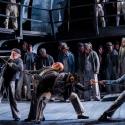
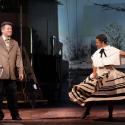
There are two top tenors on stage – Allan Clayton as the doting Jonathan, not his most rewarding part but sympathetic enough, and Stuart Jackson, who deals with more idiosyncrasy to perfection in four roles, not least a few ringing lines as "an Amalekite" on the auditorium field of battle (pictured below, with Jackson back in his first role).  The production's various coups have been well rehearsed in the review of the original production, but it's important to stress that none is gimmicky, even if the spectators are almost moved to applaud on the two curtain-ups (not being Americans, for the most part, they don't). Though a portable show, thanks to what Kosky calls the "extravagant minimalism" of using people as the props, every stage picture is a work of art in Katrin Lea Tag's design and Joachim Klein's oftewn numinous lighting. Essentially it's a stripping away, from the rigid symmetries of the first part – a few more angles might make the drama feel less long, though the singing and playing always beguile – to the very dark endgame of the later stages, rich in perspectives and symmetries with the opening scenes. Although there's now a DVD of the first run, no-one should miss Kosky's Saul in the theatre. Perhaps Glyndebourne could now think about Nielsen's magnificent Saul and David.