Once more, gondolieri! Gilbert and Sullivan's The Gondoliers leaps into life to the sound of a saltarello: a blaze of Mediterranean sunshine and good natured exuberance that sweeps you some 20 minutes into Act One on the same unbroken surge of sparkling dance and ensemble song. To say that there’s nothing quite like it in all of G&S is to ignore the fact that there’s nothing quite like it in all of 19th century European operetta. It’s still too easy to dismiss G&S as a peculiarly British phenomenon. In fact, The Gondoliers’ Venetian setting and spirited dance numbers place it firmly in the European comic opera mainstream.
The National Gilbert & Sullivan Opera Company’s touring shows aren’t known for their extravagance, exactly, but they tend to spend their money where it counts and the opening of John Savournin’s new production gives you exactly what you need. A couple of striped mooring poles and a late afternoon glow establish the scene, as the stage fills with contadine and gondoliers in traditional costumes. And then they sing: a noticeably fresh and warm chorus sound, tighter and better blended than I’ve heard from the NGSOC before. The choreography (by Mary MacDonagh) is energetic and inventive and the orchestra, too, sounds smart, full and generally on point. Credit where it’s due: they’ve got a smashing woodwind section and conductor Timothy Burke set out as he meant to continue, with considerable energy and finesse.
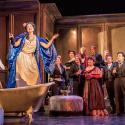
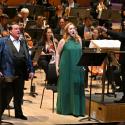
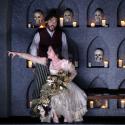
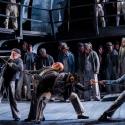
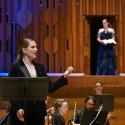
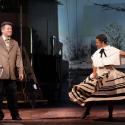
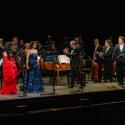
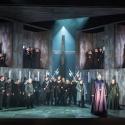
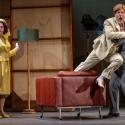
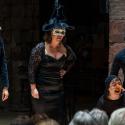
So the musical values are all there. Add Savournin’s eye for comic detail – anything from a single sideways glance to the presence of an endlessly frustrated pasta chef – and the rudimentary staging swiftly ceases to matter. (The company was unable to provide photographs of this production; the images with this review show an earlier production which nonetheless has certain visual elements in common with the current staging). We’re in the reception of the Ducal Palace Hotel, and the costumes suggest a light-touch updating to the 1920s, but it’s all so engaging and playful that really, who’s counting? So Marco (Jack Roberts) and Giuseppe (Matthew Kellett) are a pair of high-fiving doofuses in sunglasses, whose shorts-clad legs dangle childishly from an outsize throne after their sudden elevation to joint kings of Barataria. Kellett’s sunny baritone and humorous physicality played nicely off Roberts’s slightly stiffer Marco. I’d expected that Savournin might have given him a bit more to do during "Take A Pair of Sparkling Eyes", but his full-bodied, old-school delivery scored him an ovation at Buxton Opera House, and quite right too.  Emma Watkinson (Tessa) and Julia Smith (Gianetta) matched the boys for charm and vocal warmth; the measured elegance of their "Quiet, Calm Deliberation" quartet was one of those moments of purely musical beauty that make G&S so much more than just sublime silliness. Not that there was ever going to be any lack of that: not with a rubber-faced Simon Butteriss positively whirring through his patter songs in a pair of plus fours (and later a fez) as the Duke of Plaza-Toro. It takes a lot of physical grace to make clumsiness look this good. Steven Page, meanwhile, prowled about in pinstripes as an unsettlingly deadpan and sinister Grand Inquisitor.
On this side of the plot, too, the women lifted the musical level. Natalie Montakhab’s lucid, radiant soprano made Casilda easily the most regal figure on stage, but it was luxury casting to have a singer of Gaynor Keeble’s dramatic power as her mother. Gilbert’s mezzo grande dames are supposed to be thankless roles, but the Duchess of Plaza-Toro is a woman who gets what she wants, and Keeble – looking, in her fur stole, for all the world like Hergé’s Bianca Castafiore – appeared to relish every withering stare and aristocratic flick of the wrist. It’s these touches that make the difference in operetta, something that Savournin – himself an outstanding physical comedian (his current turn as Sante in Opera Holland Park’s Il Segreto di Susanna is an understated knockout) – appreciates from the inside. Don’t expect Venetian opulence or Royal Opera spectacle from this Gondoliers. But it’s a lively, funny show, with heart and voice both exactly where they should be, and it deserves to do good business.